Product
Product Facts
- Product Name
- First Aid Course | First Aid Certificate - Complete Hospitality Training
- Fulfillment Type
- online
- Category
- Education & Training > Professional Certifications & Courses
First Aid Course: Blended HLTAID011 Training and Assessment
Our HLTAID011 First Aid course uses blended delivery: self-paced online learning followed by face-to-face training and assessment. Complete the online component before attending. Our official page lists up to six hours for e-learning and four hours for the face-to-face component. Successful completion leads to a Statement of Attainment for HLTAID011.
View our official course details and booking information. Course details checked 2 October 2026.
Course background and related accredited requirements
First aid training records and current workplace competence are different questions. Check both the national assessment requirements and the refresher requirements for your role.
The units
| Code | Title | Supersedes | Equivalent? | On our scope | On scope since |
|---|---|---|---|---|---|
HLTAID009 |
Provide cardiopulmonary resuscitation | HLTAID001 |
No | Yes | 13 February 2025 |
HLTAID011 |
Provide first aid | HLTAID003 |
No | Yes | 8 April 2022 |
HLTAID014 |
Provide advanced first aid | HLTAID006 |
No | Yes | 11 July 2024 |
All three sit on our scope at extent deliver and assess, aligned to our registration period ending 30 June 2032.
All three come from the HLT Health Training Package, and HLTAID009 and HLTAID011 are Release 1, endorsed 16 October 2020. The training package is maintained by HumanAbility, the Jobs and Skills Council responsible for the health, aged care, disability and early childhood sectors. That matters for a practical reason: the body that decides what a first aid unit contains is not the body that decides how often you should redo it. Those are two different institutions, and the confusion over expiry lives in the gap between them.
HLTAID011 is the standard workplace first aid unit. HLTAID009 is CPR alone, and is contained within HLTAID011. HLTAID014 is the advanced unit for higher-risk settings.
None of the three is equivalent to its predecessor. That is a separate point from currency and it catches people out: if you hold HLTAID003, you do not hold HLTAID011, and the national register does not deem them interchangeable. The route to the current unit requires a provider’s assessment of the applicable training or recognition pathway. Non-equivalent units do not support an automatic credit transfer or replacement award.
So there are two different reasons an old first aid certificate may not do what you need: the code is superseded and not equivalent, and the training may be older than your workplace accepts. They are independent, and a provider that blurs them is not helping you.
First aid currency and refresher training
A Statement of Attainment records completed training. HLTAID011 does not set a single universal expiry period; it directs learners to the relevant work health and safety regulator for licensing, regulatory and refresher requirements.
Safe Work Australia’s model code recommends CPR refresher training annually and renewal of first aid qualifications every three years. The model code’s legal status depends on its adoption in the relevant jurisdiction. Workplace, industry and sector requirements may impose additional obligations. Confirm the requirements for your role with your employer and regulator.
Keep practising your skills between courses. Practice sessions support competence but do not replace required refresher training. See the national unit and the model first-aid code.
What the assessment actually requires
The reason a first aid unit cannot be delivered as a read-and-click course is not a policy preference. It is written into the unit's performance evidence, and the detail is specific enough to check a provider against.
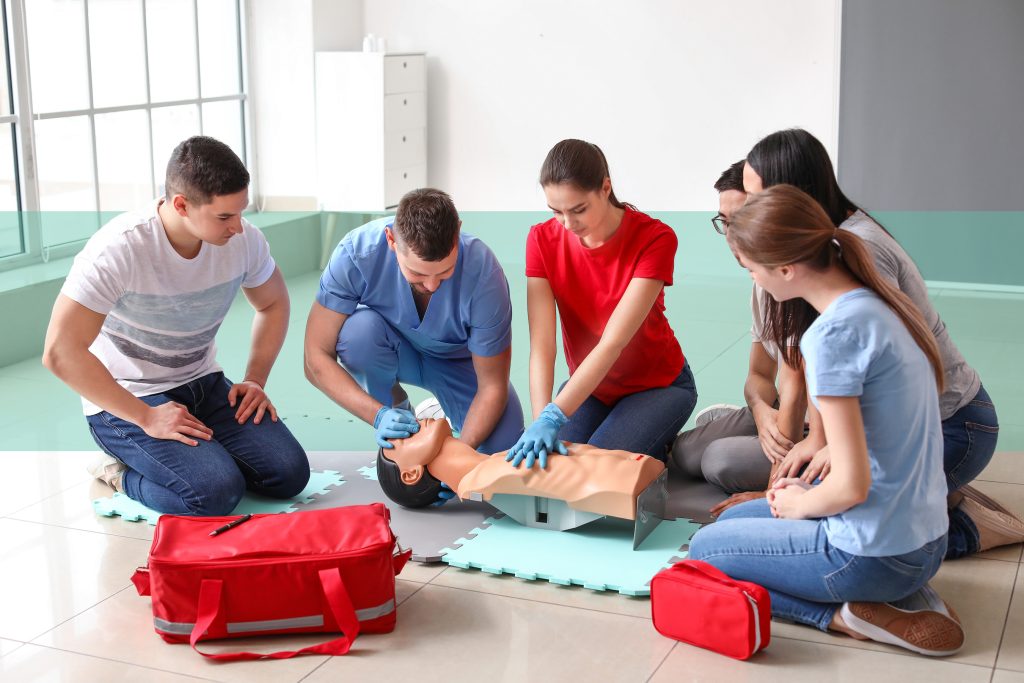
For HLTAID011, managing an unconscious, non-breathing adult, a candidate must:
- perform at least 2 minutes of uninterrupted single-rescuer CPR, being 5 cycles of both compressions and ventilations, on an adult resuscitation manikin placed on the floor
- follow the prompts of an automated external defibrillator to deliver at least one shock
- demonstrate a rotation of single-rescuer operators with minimal interruption to compressions
- respond appropriately to regurgitation or vomiting
And, separately, managing an unconscious, non-breathing infant:
- perform at least 2 minutes of uninterrupted single-rescuer CPR, again 5 cycles of compressions and ventilations, on an infant resuscitation manikin placed on a firm surface
Three things follow from that list, and each one is useful when comparing providers:
- The adult manikin goes on the floor and the infant manikin on a firm surface. Those are not stylistic notes; they are the assessment conditions, and they are why a kitchen table demonstration is not the unit.
- An AED training device is required equipment, alongside adult and infant manikins meeting Australian Resuscitation Council guidelines, and personal protective equipment. A course that never puts a defibrillator trainer in your hands has not assessed the AED requirement.
- Rotation of operators is assessed. Ask us how the practical assessment provides the required participants and equipment.
The unit does allow the performance evidence to be gathered in a simulated environment, expressly because of the nature of the training — you cannot wait for a real cardiac arrest. But the simulation must reproduce a realistic in-depth scenario with all the relevant equipment and resources of the workplace or community setting. Simulated is not the same as notional.
Why hospitality is a first aid setting
Worth stating, because it is easy to treat first aid as generic. A commercial kitchen and a busy service floor concentrate a specific set of hazards: burns and scalds, deep knife cuts, slips on wet floors, anaphylaxis from an allergen error, and choking. Late-night licensed venues add intoxicated patrons and the assessment problems that come with them.
Food safety controls help prevent incidents; first aid concerns the response when an incident occurs. Allergen management and anaphylaxis response are distinct responsibilities. See Food Safety Supervisor and food handling for the food safety pathways.
Practical notes
- First aid units cannot be completed entirely online. They require practical demonstration including manikin-based CPR assessment, to the standard set out above. Blended delivery with an in-person practical is normal; a fully online "certificate" with no practical assessment is not delivering the unit.
- Who may assess HLTAID011. Assessors must meet the applicable RTO assessor requirements and hold HLTAID011 or demonstrate equivalent skills and knowledge to that unit. Holding the CPR-only unit alone does not establish equivalence to the full first-aid unit. See the assessment conditions.
- No prerequisite qualification applies to any of the three units.
- USI arrangements. For nationally recognised training, a Unique Student Identifier (USI) is generally required before a qualification or Statement of Attainment can be issued, unless an applicable exemption applies. See the official USI exemption guidance. A USI is free at usi.gov.au. If you already have one, recover it rather than creating another.
- Check the RTO code, not the brand. We use several business names. Check the issuing RTO code as well as the name on the document. Verify it on training.gov.au.
- Confirm the current fee directly. Fees change and a figure published on a page ages badly.
Where first aid units sit in qualifications
First aid appears as an elective across a broad span of our scope, including SIT30622, SIT30821, SIT40422, SIT40521 and SIT50422, as well as the community services qualifications CHC33021, CHC43015 and CHC43415.
Completing a first aid unit standalone produces a Statement of Attainment that credit-transfers into any of those under Standard 1.7 of the Outcome Standards — no reassessment, your Statement of Attainment is the evidence. Raise it at the pre-training review, required under Standard 2.2 of the Outcome Standards for RTOs. We verify evidence of equivalent prior completion, check the training-product requirements and any licensing or regulatory restrictions, and document the decision before granting credit. See ASQA’s credit-transfer guidance.
Our scope carries 17 current qualifications, 81 current skill sets and 579 current units across sixteen training packages, including 23 current HLT health units — see about us and all courses.
One sector note: if you work in aged care, disability or childcare, food safety in those settings is covered by HLTFSE001, HLTFSE005 and HLTFSE007. Those three units are the published minimum competency standard for a food safety supervisor in the health and community services sectors in Victoria and Queensland; New South Wales names no sector units of its own. They are different units again from both first aid and the hospitality food safety units, and only HLTFSE001 is on our scope — see Food Safety Supervisor for what that means in practice.
About us
We are Complete Hospitality Training, RTO 3722, CRICOS provider code 04242E, Level 3, 28 Elizabeth Street, Melbourne VIC 3000, and 410 Elizabeth Street, Surry Hills NSW 2010. Contact melbourne@cht.edu.au or +61 3 9654 1554. See about us and all courses.
HLTAID009, HLTAID011 and HLTAID014 are on our scope of registration as deliver and assess.
We link to the relevant course and regulatory sources in this guide. Check those sources for current requirements, and confirm course availability, delivery, fees and entry requirements with us before enrolling.
Does my first aid certificate expire after three years?
The Statement of Attainment records completed training, while workplace currency is a separate requirement. Safe Work Australia’s model code recommends renewing first aid qualifications every three years and CPR annually. Confirm the applicable requirements for your role and jurisdiction.
Is the three-year rule the law?
The national unit does not set a universal expiry period. The model first-aid code recommends renewal every three years; the code’s status and any additional workplace or sector requirements depend on the jurisdiction and role. Check with the relevant regulator rather than assuming the same rule applies everywhere.
Which code of practice applies to my workplace?
Victoria uses the WorkSafe Victoria Compliance Code under the Occupational Health and Safety Act 2004. Other states and territories work from the model WHS laws and their own adopted code — SafeWork NSW publishes its own version. Safe Work Australia's document is a model code and has no force until a jurisdiction adopts it.
Does CPR really need renewing every year?
Annual CPR refresher training is the model code’s recommendation. Follow the refresher requirements for your workplace and role, and practise skills between courses. Informal practice does not replace required refresher training.
If it never expires, why refresh at all?
A training record shows what you completed on a date. Refresher training and practice help maintain current competence and meet the requirements of your role.
What exactly do I have to demonstrate to pass?
HLTAID011 includes adult and infant CPR on manikins, AED use, operator rotation, management of the listed first-aid conditions, and a simulated incident whose casualty condition is not disclosed in advance. The incident includes treatment, communication, written and verbal reporting, and review. The CPR tasks above are only part of the assessment. See the complete national requirements (https://training.gov.au/training/details/HLTAID011).
Does the assessment have to happen in a real workplace?
No. The unit expressly allows performance evidence to be collected in a simulated environment, because of the nature of the training. But the simulation must be a realistic in-depth scenario with the relevant equipment and resources of the workplace or community setting, including adult and infant manikins to Australian Resuscitation Council guidelines, AED training devices and personal protective equipment.
Who is allowed to assess me?
For HLTAID011, the assessor must meet the applicable RTO assessor requirements and hold HLTAID011 or demonstrate equivalent skills and knowledge to that unit.
I hold HLTAID003. Do I hold the current unit?
No. HLTAID011 supersedes HLTAID003 and is recorded as not equivalent. Ask us to assess the appropriate current training or recognition pathway; there is no automatic replacement award.
What is the difference between HLTAID009 and HLTAID011?
HLTAID009 is CPR alone. HLTAID011 is the broader workplace first aid unit and contains the CPR content. HLTAID014 is advanced first aid for higher-risk settings.
Which one does my workplace need?
That depends on your risk assessment and the code of practice in your jurisdiction. HLTAID011 is the usual workplace baseline.
Is the obligation different in Victoria?
Yes. Victoria operates under the Occupational Health and Safety Act 2004, which places duties on the employer, and its guidance is the WorkSafe Victoria Compliance Code. Every other jurisdiction uses the model WHS laws and the PCBU concept. A multi-state employer needs both.
Why does a hospitality venue need first aid?
Burns and scalds, knife cuts, slips on wet floors, choking and anaphylaxis are all concentrated in kitchens and service floors. Late-night licensed venues add intoxicated patrons.
Is allergen management the same as first aid?
No. Allergen management concerns food safety and preventing exposure. First-aid training includes responding to anaphylaxis. They address different responsibilities.
Does it count toward a qualification?
Yes. First aid units are electives across most of our hospitality and community services qualifications and credit-transfer on enrolment under Standard 1.7, with no reassessment. We verify evidence of equivalent prior completion, check the training-product requirements and any licensing or regulatory restrictions, and document the decision before granting credit. See ASQA’s credit-transfer guidance (https://www.asqa.gov.au/for-providers/standards-for-RTOs/practice-guides/quality-area-1-training-and-assessment/RPL-and-credit-transfer-practice-guide).
Can I do first aid entirely online?
No. The units require practical demonstration, including manikin-based CPR assessment with an AED training device. Blended delivery with an in-person practical component is normal; a fully online first aid "certificate" with no practical assessment is not delivering the unit.
Are there prerequisites?
No prerequisite qualification applies to any of the three units.
Do I need a USI?
For nationally recognised training, a USI is generally required before your qualification or Statement of Attainment can be issued, unless an applicable exemption applies. We can explain the requirements for your enrolment. See the official USI exemption guidance (https://www.usi.gov.au/students/create-your-usi/exemptions-usi). Creating a USI is free; recover an existing one rather than creating another.
What document do I receive?
A Statement of Attainment naming the unit, issued by the RTO, appearing on your national training transcript against your Unique Student Identifier.
Images on This Page
-
https://cht.edu.au/wp-content/uploads/2022/04/cht_logo_web_land.svg
logo
-
https://cht.edu.au/wp-content/uploads/2022/04/cht_logomark_webb.png
logo
-
https://cht.edu.au/wp-content/uploads/2022/04/cht_logo_rgb.svg
logo
-
https://cht.edu.au/wp-content/uploads/2023/02/AdobeStock_87238802-scaled.jpeg
(no alt text)
-
https://cht.edu.au/wp-content/uploads/2023/02/AdobeStock_323817943_firstaid-scaled.jpg
(no alt text)
-
https://cht.edu.au/wp-content/uploads/2023/02/cpr-demo-1024x701.jpg
(no alt text)
-
https://lh3.googleusercontent.com/a/ACg8ocJ-puyA58EhqUTWnkEBYthdoyjGqBClo8pgjkEc62XJFyEcios=s64-c-rp-mo-br100
Wilson Jong Avatar
-
https://cht.edu.au/wp-content/uploads/wprevslider/review-images/review-image-6a8fea99820f7-0.jpg
media thumbnail 0
-
https://lh3.googleusercontent.com/a-/ALV-UjVp5co4oMmzh_oglgOJfw4qElOkMav7cqQrA0Ab73ZvHNz3jw=s64-c-rp-mo-br100
Daniel Rose Avatar
-
https://lh3.googleusercontent.com/a/ACg8ocKZhz7LC6bpJvfFepZx8DP_cOt19k9V9mwd74VIXhr4ZBc-Jg=s64-c-rp-mo-br100
Deepak Pandey Avatar
-
https://lh3.googleusercontent.com/a/ACg8ocKIRvEWLr_ZRqWJ1vjJS5d8mXyP8L1PGSXIocv7xCA7hdfsRg=s64-c-rp-mo-br100
Eva Di Betta Avatar
-
https://lh3.googleusercontent.com/a/ACg8ocLRBODw2wvVCVq32OhlqXf0vvSJ2X7v02_5F8C9vYpi24c9BA=s64-c-rp-mo-br100
Johanna Gruber Avatar
-
https://lh3.googleusercontent.com/a/ACg8ocILWfQ1_yhwr2yRiNWG23i-AEJH4AAWPbc2DruvBzdvTgzsJj0=s64-c-rp-mo-br100
Chloe Morgan Avatar
-
https://lh3.googleusercontent.com/a-/ALV-UjVoB0LNfm2rKFH6CBWC3BylC9uquuPIvNcdfZ-uqtsTYdSFI7oB=s64-c-rp-mo-br100
Prajwal Tiwary Avatar
-
https://lh3.googleusercontent.com/a-/ALV-UjUdbsguY0kA7b-hExHRAu8hXi6gsBspMUBXgQG48lQtKq7JTfc=s64-c-rp-mo-br100
Aiden Tran (Hurricade) Avatar
-
https://lh3.googleusercontent.com/a/ACg8ocJ6zQ15V-c8PmfUip7aDbGRv5Ezck6buI3o_whW9EH83PdkrQ=s64-c-rp-mo-br100
kristy Nicholls Avatar
-
https://lh3.googleusercontent.com/a/ACg8ocL4ZRzGN_uhMscCsHExvs8QVTa_5FN5A_UL30u6fyF1smEhvw=s64-c-rp-mo-br100
David Peter Nair Avatar
-
https://lh3.googleusercontent.com/a/ACg8ocJOzo657HBfWpdQbk3Pcv75BjERtCxH3gWnpFS3YQOwUhC5Ew=s64-c-rp-mo-br100
Leijing Shan Avatar
-
https://lh3.googleusercontent.com/a-/ALV-UjUSACDMz7QBi3EqFlgrZgYnnqHiq-FRQOMSEPB8r5vldRbY9y0e=s64-c-rp-mo-br100
Yorda Avatar
-
https://lh3.googleusercontent.com/a/ACg8ocJmXLU2_G7iqnAIvUTpP5a2ucqac8UQZBvmA1Ojq8PTPjoX=s64-c-rp-mo-br100
Senoleita Avatar
-
https://lh3.googleusercontent.com/a/ACg8ocKqM3oNIJCIXWrsLwNnEuXLXXLX0BmPYHGl4MR0o4oQp0xewA=s64-c-rp-mo-br100
Ava Fraser Avatar
-
https://lh3.googleusercontent.com/a/ACg8ocLPh4gzfKLPKcG228rZ_Gay9Vs1DqdMUvYW2pRNs80w3Q5y7Q=s64-c-rp-mo-ba2-br100
Thảo Trần Avatar
-
https://cht.edu.au/wp-content/uploads/wprevslider/review-images/review-image-6a0d660a1455a-0.jpg
media thumbnail 0
-
https://lh3.googleusercontent.com/a-/ALV-UjVdkOTdbHd9qL3nEyv1CA5ovNpUpU13MqLZaa-kX8v6WP9F6mtN=s64-c-rp-mo-ba2-br100
Luke Willis Avatar
-
https://lh3.googleusercontent.com/a-/ALV-UjUwvCwkXjSWn7_S2qV1Cyb4zXFsLA-wXIt1EiqanPR_QSfKrmxi=s64-c-rp-mo-ba4-br100
Axel Gomez Avatar
-
https://lh3.googleusercontent.com/a-/ALV-UjX6tAd5ZRPSbwkGIXRajo4rNMJDcTGXxHboMZqzx8wZAfOvvU4=s120-c-rp-mo-br100
Rahul Aravindth Avatar
-
https://lh3.googleusercontent.com/a-/ALV-UjUASBtqUpwR0elJMaY2zqzGSuxv9zlHQxkyKtDBbbQeEWs-mYCKMQ=s120-c-rp-mo-br100
Alex Dimelow Avatar
-
https://lh3.googleusercontent.com/a-/ALV-UjUPKOsxrfcSAuyfLzzMwlNb-tKCcco8a1ViIWk43YxlhSaxtds=s120-c-rp-mo-br100
Jeremy Rocca Avatar
-
https://lh3.googleusercontent.com/a/ACg8ocK9FFeitBJaC2-7F09h51sCAAnjDUcz_mFshLFl1LCW9DLx0A=s120-c-rp-mo-br100
Alkim Avatar
-
https://lh3.googleusercontent.com/a-/ALV-UjU0nAqPYVt9FJNqZjKKKj2sSn3KGYDsPo-q05G8ru5krvmL3uRL=s120-c-rp-mo-br100
Lawrence Miha Avatar
-
https://cht.edu.au/wp-content/uploads/2024/08/nationally.svg
nationally
-
https://cht.edu.au/wp-content/uploads/2024/08/quality.svg
nationally
-
https://cht.edu.au/wp-content/uploads/2024/08/art.svg
nationally
-
https://cht.edu.au/wp-content/uploads/2024/08/established.svg
nationally
-
https://cht.edu.au/wp-content/uploads/2024/08/service.svg
nationally
-
https://cht.edu.au/wp-content/uploads/2022/04/cht_logo_wht.svg
(no alt text)
-
https://cht.edu.au/wp-content/uploads/2023/02/facebook.svg
Facebook
-
https://cht.edu.au/wp-content/uploads/2023/02/instagram.svg
Instagram
-
https://cht.edu.au/wp-content/uploads/2023/02/youtube.svg
YouTube
-
https://cht.edu.au/wp-content/uploads/2023/02/tiktok.svg
TikTok
-
https://cht.edu.au/wp-content/uploads/2023/02/linkedin.svg
LinkedIn
-
https://cht.edu.au/wp-content/uploads/2023/12/flags.png
(no alt text)
-
https://cht.edu.au/wp-content/themes/cht/images/close-icon.png
(no alt text)