Product
Product Facts
- Product Name
- Coffee Tasting, Appreciation and Roasting Course - Melbourne, VIC - Complete Hospitality Training
- Fulfillment Type
- online
- Category
- Education & Training > Professional Courses & Certifications

Coffee Appreciation: Our Three-Hour Non-Accredited Course and Alternatives
Our Coffee Appreciation course is a three-hour, non-accredited session. We issue a Certificate of Participation, and there is no competency assessment or prerequisite unit. Participants must be at least 16 when the course starts. The accredited coffee and beverage units discussed below are alternative pathways, not outcomes of this session.
View our official course details and booking information. Course details checked 2 October 2026.
Course background and related accredited requirements
"Coffee appreciation" is not a nationally accredited unit of competency. It is a descriptive name for tasting and technique sessions, which can be genuinely worthwhile but do not produce a nationally recognised credential.
The accredited units that cover coffee sit in the SIT Tourism, Travel and Hospitality Training Package. Two of them cover making the drinks, a third covers promoting coffee appreciation as an assessed outcome, and a skill set covers beverage advice. This page sets out what each requires, so you can tell which one you need and what document you will hold at the end.
The two accredited units
SITHFAB025 |
SITHFAB024 |
|
|---|---|---|
| Title | Prepare and serve espresso coffee | Prepare and serve non-alcoholic beverages |
| Covers | Espresso-based coffee only | Ten categories of non-alcoholic drink |
| Prerequisite | SITXFSA005 Use hygienic practices for food safety |
SITXFSA005 — the same prerequisite |
| Service periods | Not specified | 3, including one peak |
| Produces | Statement of Attainment | Statement of Attainment |
If your interest is espresso specifically — the machine, the grind, the extraction, milk texture — SITHFAB025 is the unit. If you work in a cafe that also makes smoothies, juices, milkshakes and teas, SITHFAB024 covers that wider range.
Both carry the same prerequisite, which is the single most useful planning fact on this page: clearing SITXFSA005 once opens both units. An earlier version of this page said SITHFAB024 had no prerequisite; that was wrong, and the training package unit records confirm the requirement.
In fact SITXFSA005 opens nine units in the current food and beverage stream, not two. It is the mandatory prerequisite for SITHFAB022 Clean and tidy bar areas, SITHFAB023 Operate a bar, SITHFAB024, SITHFAB025, SITHFAB026 Provide room service, SITHFAB027 Serve food and beverage, SITHFAB030 Prepare and serve cocktails, SITHFAB034 Provide table service of food and beverage and SITHFAB035 Provide silver service, which makes it the gateway unit for the whole food and beverage stream and the obvious thing to sequence first. Keep that figure scoped to food and beverage: across the wider SIT package SITXFSA005 also gates cookery, patisserie, Asian cookery and kitchen units, so a total for the whole package would be a different number about a different set of units.
The unit that actually says "coffee appreciation"
This is the part almost nobody looking for a coffee appreciation course is told, and it is the closest thing in the national system to what the phrase describes.
SITHFAB038 Plan and monitor espresso coffee service is current on our scope as RTO 3722 at extent "deliver and assess" to 30 June 2032. Its second element is Provide specialist advice on espresso coffee beverages, and its performance criteria require the candidate to develop and update their own knowledge of coffee beverages, respond to customer questions, provide accurate information to staff, and promote coffee appreciation. That phrase is in the unit.
Its third element, Monitor quality of coffee beverages, is the tasting half. It requires the candidate to identify the desirable characteristics of superior espresso coffee, evaluate bean freshness, monitor grind and dose consistency and assess beverage quality. And its performance evidence sets out the sensory vocabulary the register expects, requiring monitoring of the consistency and quality of eight named characteristics throughout service:
| # | Characteristic |
|---|---|
| 1 | Appearance, including opacity or transparency |
| 2 | Aroma |
| 3 | Colour |
| 4 | Flavour |
| 5 | Freshness |
| 6 | Presentation |
| 7 | Taste |
| 8 | Volume |
Aroma, flavour, freshness and taste are four of the eight. If what you want from a coffee appreciation course is a structured way to judge a cup and talk about it, that is the accredited list to work from.
The rest of the unit is the operational side: element 1 covers developing coffee beverage menus and selecting suppliers and roasters, and element 4 covers monitoring machines and equipment, temperature and water pressure, developing environmentally sound practices and scheduling service calls. Its performance evidence requires coordinating an outlet's coffee operation across at least six service periods.
Two useful facts about it. SITHFAB038 has no prerequisite units at all — not SITXFSA005, and not even SITHFAB025 — so an experienced barista or cafe owner can be assessed in it directly. And the contrast in volume tells you what it is for: SITHFAB025 counts beverages and occasions because it assesses making coffee; SITHFAB038 counts service periods because it assesses running and judging a coffee programme.
The skill set for the advisory side
If the machine is not the point for you, there is a coded alternative. SITSS00075 Beverage Advice is a nationally recognised skill set on our scope, aimed at the advisory half of beverage work rather than at operating equipment. For anyone whose real interest is knowing and explaining what is in the glass or the cup, that is the code to ask about rather than an espresso unit.
The same logic runs across the other product areas, and it is worth knowing these exist because they are rarely advertised:
| Skill set | What it targets |
|---|---|
SITSS00075 Beverage Advice |
Advising customers on beverages |
SITSS00083 Food Advice |
Advising customers on food |
SITSS00094 Sommelier |
Wine, at specialist depth |
SITSS00080 Espresso Machine Operation |
Operating the machine |
The food-advice units behind that second row also show what accredited tasting looks like when it is assessed. SITHFAB036 Provide advice on food requires the candidate to discuss the characteristics of major food types with at least three different customers, to use sensory evaluation techniques on at least one occasion — the unit names smell or nose appraisal, taste appraisal and visual appraisal — and to maintain and continuously extend personal knowledge of major food types. SITHFAB037 Provide advice on food and beverage matching requires explaining how aroma, taste or flavour, temperature, texture and cookery method affect compatible matches, again with at least three customers.
One detail in those units is worth carrying into any appreciation course: each requires advice that meets the customer's taste and price preferences. The accredited standard for product advice is serving the preference the person actually has, including a preference to spend less, not steering them to the premium option.
SITHFAB025 Prepare and serve espresso coffee
What is actually assessed
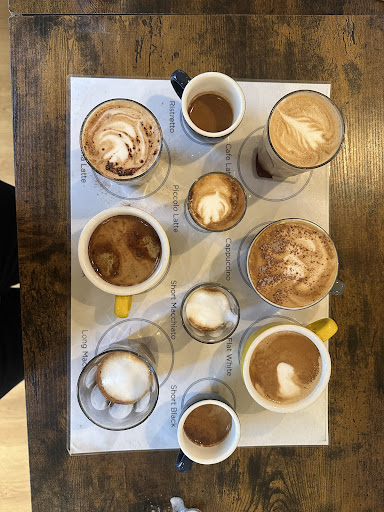
To be assessed as competent, a candidate must prepare and present each of the following espresso-based beverages on three different occasions, within commercial timeframes:
- Caffe latte
- Cappuccino
- Espresso (short black)
- Flat white
- Long black
- Piccolo latte
- Mocha
- Ristretto
- Short macchiato
- Long macchiato
That is ten beverages, three occasions each — thirty separate preparations at minimum, each within the time a paying customer would accept.
Count the milk and the shape of the assessment becomes clear. Only three of the ten are milk-free — espresso (short black), long black and ristretto — because both macchiatos and the mocha take milk. So seven of the ten require textured milk, and 21 of the 30 minimum preparations depend on it. See milk texturing 101.
The candidate must also monitor quality indicators for extraction during preparation and make adjustments to restore extraction to the required standard. This is the part that separates the unit from a demonstration class. It is not enough to produce a good coffee; you have to recognise when extraction has drifted and correct it. The unit names the five variables adjusted to do so: dose, grind, tamping technique, water flow and water pressure. The quality factors it names are ambient humidity, crema, espresso flow, steam pressure and taste.
The knowledge evidence covers types and characteristics of each beverage, different types of milk and their uses, characteristics of different beans, blends and roasts, and mise en place requirements. The customer-preference options it names are accompaniments, blends, service-ware, strength, sweeteners, types of beans and types of milk — which is the closest SITHFAB025 comes to appreciation, and it is framed as advising a customer rather than as tasting for its own sake.
SITHFAB024 Prepare and serve non-alcoholic beverages
What is actually assessed
The candidate must prepare and present at least six different non-alcoholic beverages, on three occasions each, drawn from:
- Carbonated drinks
- Non-espresso coffees
- Frappés
- Freshly squeezed juices
- Hot chocolate
- Iced chocolate or coffee
- Milkshakes
- Mocktails
- Smoothies
- Teas
Alongside that, service must be delivered over a minimum of three different service periods, including at least one peak service period.
Beverages must be prepared within commercial timeframes and with consistent quality, volume and appearance, using correct equipment, ingredients and standard measures.
Note the phrase "non-espresso coffees" in that list. SITHFAB024 deliberately excludes espresso, which is why the two units complement rather than overlap each other.
The service-period requirement is the scheduling constraint
SITHFAB024's three service periods, one of them a peak, cannot be compressed into a single session — which rules out a one-day format for this unit whatever a timetable claims. SITHFAB025 has no service-period requirement of its own, and that is worth stating plainly because providers sometimes advertise one: the espresso unit's whole volume is ten beverages on three occasions each within commercial timeframes. Those thirty preparations create a similar practical floor, but they are not service periods, and a peak-shift requirement attributed to SITHFAB025 is a delivery choice rather than a training package rule.
If you are planning several beverage units, each unit needs its required evidence. Integrated assessment may cover multiple units when all requirements are met:
| Unit | Requirement |
|---|---|
SITHFAB024 Non-alcoholic beverages |
3 service periods, one peak |
SITHFAB025 Espresso coffee |
10 beverages × 3 occasions, commercial timeframes, no service periods |
SITHFAB027 Serve food and beverage |
5 service periods, one peak |
SITHFAB034 Provide table service |
12 service periods, full menu advice in each |
SITHFAB030 Prepare and serve cocktails |
3 service periods, 2 cocktails × 6 methods |
SITHFAB038 Plan and monitor espresso coffee service |
6 service periods, coordinating an outlet |
SITHFAB036 / SITHFAB037 Advice units |
3 different customers each |
A venue supporting someone across several of these needs the rostering to match.
The prerequisite, and the tidy way round it
Both beverage units require SITXFSA005 Use hygienic practices for food safety to be completed or already held. Three ways to satisfy it:
- Take a skill set that includes it.
SITSS00080Espresso Machine Operation is on our scope and packagesSITHFAB025together withSITXFSA005,SITXCCS014Provide service to customers andSITXFIN007Process financial transactions — the espresso unit plus its prerequisite plus the service and cash-handling units a cafe worker actually uses. Its target group is espresso machine operators in cafes, restaurants, bars, clubs, and function and event venues, and it provides credit towards SIT Training Package qualifications. No occupational licensing, certification or legislative requirement applies to it — there is no licence to make or sell coffee in Australia. - Clear it in advance through food handling or virtual food handling.
- Already hold it.
SITXFSA005is core in SIT30722 Certificate III in Hospitality (Restaurant Front of House), and is one of two options in the compulsory Group A of SIT30622 and SIT40422.
If you hold SITXFSA005 from any Australian RTO, that is credit transfer under Standard 1.7 of the Outcome Standards — your Statement of Attainment is the evidence and there is no reassessment. Raise it at the pre-training review, required under Standard 2.2 of the Outcome Standards for RTOs. We first verify the evidence and equivalence, check that the units fit your training product, and check for licensing or regulatory restrictions before granting credit. See ASQA’s credit-transfer guidance.
We hold 81 current skill sets, 22 in the SIT hospitality package, and most are not advertised as courses. See all courses, and name the code when you enquire.
Cafe work makes you a food handler
Which is why the prerequisite exists rather than being an administrative nuisance. Handling milk, cutting fruit for a juice, plating a pastry or handling ice is handling food, and that brings you inside Standard 3.2.2A of the Food Standards Code, in force since 8 December 2023.
That obligation is lighter than most people assume: the training must cover safe food handling, food contamination, cleaning and sanitising, and personal hygiene — or you must possess skills and knowledge commensurate with the activity. It does not have to be nationally accredited, mandates no refresher period, and the business is not required to keep records of it.
So SITXFSA005 is not what makes you lawful. It is what makes you provable and portable — and here it is also the gate to both beverage units. The five-year clock people associate with food safety belongs to the separate Food Safety Supervisor certificate, not to a food handler. See Food Safety Supervisor.
On allergens and milk substitutes this page states no legal duty, because there is none in the material behind it and inventing one would be worse than the gap. Separate jugs and proper cleaning where a dairy allergy rather than an intolerance is involved is sound practice; for the legal requirement your state or territory food regulator is the authority.
Accredited or not: how to tell
This is the practical question, and the check takes a moment.
An accredited outcome produces a Statement of Attainment issued by a registered training organisation. It names the unit code, appears on your national training transcript against your Unique Student Identifier, and can be verified by an employer through the issuing RTO. It never expires.
A non-accredited outcome produces a certificate of attendance, completion or participation. It may be a well-run course, but it is not nationally recognised, it does not appear on your transcript, and it does not count toward a qualification.
The simplest test: look for the unit code and the RTO number. If a course description does not name SITHFAB025 or SITHFAB024 and does not carry an RTO number, it is not producing a Statement of Attainment for those units.
The brand check, with the actual names
An RTO may trade under several registered business names, so the RTO code identifies the issuer, not the brand. An unfamiliar name on a certificate is not evidence of a problem, and a familiar one is not evidence of legitimacy.
The Australian Business Register records seven current registered business names for the legal entity COMPLETE HOSPITALITY TRAINING (VIC.) PTY. LTD., ABN 27 006 947 262, three of them coffee names:
| Registered business name | Registered from |
|---|---|
| COMPLETE HOSPITALITY TRAINING | 12 Dec 2011 |
| THE COFFEE SCHOOL | 25 Nov 2020 |
| Coffee School by CHT | 20 May 2021 |
| Melbourne Barista | 14 Jun 2017 |
| Victorian Bar School | 6 Mar 2018 |
| Ready Serve Achieve Melbourne | 6 Mar 2018 |
| Alchemy Institute of Australia | 12 Sep 2024 |
So "The Coffee School", "Coffee School by CHT" and "Melbourne Barista" are names of the same legal entity as Complete Hospitality Training, and accredited training delivered under any of them is delivered by RTO 3722. "Complete Hospitality Training" is itself a registered business name; the legal entity name carries "(VIC.)" and "PTY. LTD.". The dates are business-name registration dates from the register and nothing more — not statements about when any course began. Verify the code on training.gov.au.
A plausibility check helps too. Thirty espresso preparations within commercial timeframes, or three service periods including a peak, is not a two-hour tasting session. If the duration and the claimed unit do not fit together, one of them is wrong.
When non-accredited is the right choice
Worth saying, because the accredited-versus-not framing can imply the accredited option is always better. It is not.
If you already hold the units and want to refine milk texture, dial in a grinder, or work through single-origin tasting, a non-accredited session aimed squarely at that is a better use of your time than re-sitting a unit you already have. A tasting and appreciation course is also simply a different thing from a competency assessment, and there is nothing wrong with wanting the former. The distinction to hold onto is what document you walk away with, and whether you needed one.
If you do want appreciation with a national credential attached, the honest answer is that there are two routes and neither is called a coffee appreciation course: SITSS00075 Beverage Advice, or SITHFAB038, whose element 2 includes promoting coffee appreciation and whose element 3 covers judging a superior cup and evaluating bean freshness.
Where these units fit in a qualification
Both beverage units are elective units rather than core.
SITHFAB025 appears as an elective in SIT30622, SIT30722 and SIT40422 Certificate IV in Hospitality. SITHFAB024 appears as an elective in SIT40422 and in the Certificate III elective lists. Neither is core in any of our qualifications.
Completing either as a standalone unit produces a Statement of Attainment which can later be credit-transferred into a full qualification, so short-course study is not wasted if you go on to enrol.
For nationally recognised training, a USI is generally required before a qualification or Statement of Attainment can be issued, unless an applicable exemption has been granted. This requirement does not apply to the non-accredited workshop described at the top of this page. See the official USI exemption guidance.
What a single unit is, and is not, worth for pay
A single unit does not move your award classification. A completed Certificate III, relevant to your work and actually used at work, sets a minimum classification of Level 4 under three of the four awards that cover hospitality premises — MA000009 (cl 18.1), MA000119 (cl 18.1) and MA000058 (cl 18.3). The fast food award, MA000003, has no equivalent provision.
For cafe work that produces a sharp distinction. A standalone cafe is MA000119, so the qualification argument works there. A food-court coffee counter is MA000003, so it does not — MA000003 covers food and beverages sold primarily to be consumed away from the point of sale and expressly excludes cafes providing primarily a sit-down service. The test is sit-down service, not the menu, and it is the same person on the same machine either way.
Under MA000119 the Level 4 classification is defined in Schedule A as Food and beverage attendant grade 4 (tradesperson), and the award's own "standard rate" is the Level 4 rate.
So the honest position on a short course: it gets you employable and it credit-transfers, and the classification outcome comes from finishing a qualification rather than from the unit. No pay rates are published here — award rates re-set every 1 July, so use the Fair Work Ombudsman's Pay and Conditions Tool with your award code.
Related pages
For the artistic side of milk texturing and pouring, see latte art — which explains where that sits relative to the assessed requirements of SITHFAB025.
For the master-class format and what extra machine time actually buys, see barista master class, and for the standard format barista coffee course.
For food and beverage service more broadly, see restaurant waiting, covering SITHFAB027 and SITHFAB034. For how coffee is drunk rather than made, brewed together.
About us
We are Complete Hospitality Training, RTO 3722, CRICOS 04242E, Level 3, 28 Elizabeth Street, Melbourne VIC 3000, and 410 Elizabeth Street, Surry Hills NSW 2010. Contact melbourne@cht.edu.au or +61 3 9654 1554. See about us and all courses.
The legal entity is COMPLETE HOSPITALITY TRAINING (VIC.) PTY. LTD., ABN 27 006 947 262, ACN 006 947 262.
SITHFAB024, SITHFAB025, SITHFAB038 and the SITSS00080 Espresso Machine Operation, SITSS00075 Beverage Advice, SITSS00083 Food Advice and SITSS00094 Sommelier skill sets are all on our scope of registration as deliver and assess. Completing any of them produces a nationally recognised Statement of Attainment.
We link to the relevant course and regulatory sources in this guide. Check those sources for current requirements, and confirm course availability, delivery, fees and entry requirements with us before enrolling. Assessment wording clarified on 2 October 2026. SIT implementation guide, section 6.3.
Is "coffee appreciation" a nationally recognised course?
No. It is not a unit of competency. The accredited units covering coffee are SITHFAB025 for espresso and SITHFAB024 for non-alcoholic beverages more generally, with SITHFAB038 covering specialist advice and quality monitoring.
Is there any accredited unit that covers appreciation itself?
The closest is SITHFAB038 Plan and monitor espresso coffee service. Element 2 requires the candidate to develop and update coffee knowledge, respond to customer questions, inform staff and promote coffee appreciation; element 3 requires identifying the characteristics of superior espresso and evaluating bean freshness.
Is there a skill set for coffee knowledge rather than machine skill?
SITSS00075 Beverage Advice, on our scope. SITSS00083 Food Advice and SITSS00094 Sommelier are the equivalents for food and wine.
What sensory characteristics does the register actually name?
For coffee, SITHFAB038 names eight: appearance including opacity or transparency, aroma, colour, flavour, freshness, presentation, taste and volume. For food, SITHFAB036 names three sensory evaluation techniques: smell or nose appraisal, taste appraisal and visual appraisal.
How many coffees do I have to make to pass SITHFAB025?
Ten specified beverages, three occasions each, within commercial timeframes — a minimum of thirty preparations, plus demonstrating that you can identify and correct extraction problems.
How many of the ten involve milk?
Seven. Only espresso (short black), long black and ristretto are milk-free. So 21 of the 30 minimum preparations depend on textured milk.
Do I need anything before I can do SITHFAB025?
Yes. SITXFSA005 Use hygienic practices for food safety is a prerequisite and must be completed or already held.
Does SITHFAB024 have a prerequisite too?
Yes — the same one, SITXFSA005. So clearing it once opens both units, and in fact nine in total in the current food and beverage stream. The SITSS00080 skill set includes it.
Which units in the food and beverage stream does SITXFSA005 open?
Nine: SITHFAB022 Clean and tidy bar areas, SITHFAB023 Operate a bar, SITHFAB024, SITHFAB025, SITHFAB026 Provide room service, SITHFAB027 Serve food and beverage, SITHFAB030 Prepare and serve cocktails, SITHFAB034 Provide table service and SITHFAB035 Provide silver service. SITHFAB023, SITHFAB030 and SITHFAB034 additionally require SITHFAB021 RSA, and SITHFAB030 requires SITHFAB023 as well. RSA is the equal of the food safety unit here: SITHFAB021 is itself a prerequisite to nine units in the stream. SITHFAB038 requires nothing at all.
What is the difference between SITHFAB024 and SITHFAB025?
SITHFAB025 is espresso only. SITHFAB024 covers ten categories of non-alcoholic drink and explicitly excludes espresso, referring instead to non-espresso coffees.
Does SITHFAB024 have a service period requirement?
Yes. A minimum of three different service periods, including at least one peak period — which rules out completing it in a single session.
Does SITHFAB025 have one?
No. It is the one unit in the beverage stream with no service-period requirement at all. If a provider tells you the espresso unit needs a peak shift, that is their delivery model rather than a training package rule.
What is SITSS00080?
The Espresso Machine Operation skill set on our scope. It packages SITHFAB025 with SITXFSA005, SITXCCS014 and SITXFIN007 — the espresso unit plus its prerequisite plus service and cash handling. It provides credit towards SIT Training Package qualifications, and no occupational licensing requirement applies to it.
Do I need a food safety certificate to work in a cafe?
Handling milk, fruit, pastries or ice makes you a food handler under Standard 3.2.2A, so the training requirement applies. It does not have to be accredited — but SITXFSA005 is the prerequisite for both beverage units, so the accredited version is worth holding.
What document do I receive?
A Statement of Attainment naming the unit, issued by the RTO. It appears on your national training transcript against your Unique Student Identifier and does not expire.
Can these units count toward a qualification later?
Yes. Both are electives in CHT qualifications, so a Statement of Attainment can be credit-transferred under Standard 1.7 if you enrol in a full qualification afterwards, with no reassessment. We verify evidence of equivalent prior completion, check the training-product requirements and any licensing or regulatory restrictions, and document the decision before granting credit. See ASQA’s credit-transfer guidance (https://www.asqa.gov.au/for-providers/standards-for-RTOs/practice-guides/quality-area-1-training-and-assessment/RPL-and-credit-transfer-practice-guide).
Are "The Coffee School" and "Melbourne Barista" the same organisation as CHT?
Yes. Both, with "Coffee School by CHT", are current registered business names of COMPLETE HOSPITALITY TRAINING (VIC.) PTY. LTD., ABN 27 006 947 262, on the Australian Business Register. Accredited training under them is delivered by RTO 3722.
Will a coffee unit increase my pay?
Not on its own. A completed Certificate III, used at work, sets a Level 4 minimum under MA000119, MA000009 and MA000058 — but not under MA000003, the fast food award that covers food courts.
Is a non-accredited course ever the better choice?
Yes, if you already hold the units and want to refine technique, or if tasting and appreciation is what you actually want. The point is knowing which document you will hold, not that one is always superior.
How do I check whether a coffee course is accredited?
Look for the unit code and the RTO number, and check the code rather than the brand name. A course that produces a branded certificate of attendance rather than a Statement of Attainment is not nationally recognised, however well taught.
Do I need a USI for this non-accredited workshop?
No USI is required for the non-accredited workshop described above. If you choose a nationally recognised unit instead, a USI is generally required unless an applicable exemption has been granted. Ask us about the requirements for the course you intend to book.
Images on This Page
-
https://cht.edu.au/wp-content/uploads/2022/04/cht_logo_web_land.svg
logo
-
https://cht.edu.au/wp-content/uploads/2022/04/cht_logomark_webb.png
logo
-
https://cht.edu.au/wp-content/uploads/2022/04/cht_logo_rgb.svg
logo
-
https://cht.edu.au/wp-content/uploads/2020/11/banner_coffee-farm.jpg
(no alt text)
-
https://cht.edu.au/wp-content/uploads/2020/08/AdobeStock_170477204-e1604277256426.jpg
(no alt text)
-
https://lh3.googleusercontent.com/a/ACg8ocJ-puyA58EhqUTWnkEBYthdoyjGqBClo8pgjkEc62XJFyEcios=s64-c-rp-mo-br100
Wilson Jong Avatar
-
https://cht.edu.au/wp-content/uploads/wprevslider/review-images/review-image-6a8fea99820f7-0.jpg
media thumbnail 0
-
https://lh3.googleusercontent.com/a-/ALV-UjVp5co4oMmzh_oglgOJfw4qElOkMav7cqQrA0Ab73ZvHNz3jw=s64-c-rp-mo-br100
Daniel Rose Avatar
-
https://lh3.googleusercontent.com/a/ACg8ocKZhz7LC6bpJvfFepZx8DP_cOt19k9V9mwd74VIXhr4ZBc-Jg=s64-c-rp-mo-br100
Deepak Pandey Avatar
-
https://lh3.googleusercontent.com/a/ACg8ocKIRvEWLr_ZRqWJ1vjJS5d8mXyP8L1PGSXIocv7xCA7hdfsRg=s64-c-rp-mo-br100
Eva Di Betta Avatar
-
https://lh3.googleusercontent.com/a/ACg8ocLRBODw2wvVCVq32OhlqXf0vvSJ2X7v02_5F8C9vYpi24c9BA=s64-c-rp-mo-br100
Johanna Gruber Avatar
-
https://lh3.googleusercontent.com/a/ACg8ocILWfQ1_yhwr2yRiNWG23i-AEJH4AAWPbc2DruvBzdvTgzsJj0=s64-c-rp-mo-br100
Chloe Morgan Avatar
-
https://lh3.googleusercontent.com/a-/ALV-UjVoB0LNfm2rKFH6CBWC3BylC9uquuPIvNcdfZ-uqtsTYdSFI7oB=s64-c-rp-mo-br100
Prajwal Tiwary Avatar
-
https://lh3.googleusercontent.com/a-/ALV-UjUdbsguY0kA7b-hExHRAu8hXi6gsBspMUBXgQG48lQtKq7JTfc=s64-c-rp-mo-br100
Aiden Tran (Hurricade) Avatar
-
https://lh3.googleusercontent.com/a/ACg8ocJ6zQ15V-c8PmfUip7aDbGRv5Ezck6buI3o_whW9EH83PdkrQ=s64-c-rp-mo-br100
kristy Nicholls Avatar
-
https://lh3.googleusercontent.com/a/ACg8ocL4ZRzGN_uhMscCsHExvs8QVTa_5FN5A_UL30u6fyF1smEhvw=s64-c-rp-mo-br100
David Peter Nair Avatar
-
https://lh3.googleusercontent.com/a/ACg8ocJOzo657HBfWpdQbk3Pcv75BjERtCxH3gWnpFS3YQOwUhC5Ew=s64-c-rp-mo-br100
Leijing Shan Avatar
-
https://lh3.googleusercontent.com/a-/ALV-UjUSACDMz7QBi3EqFlgrZgYnnqHiq-FRQOMSEPB8r5vldRbY9y0e=s64-c-rp-mo-br100
Yorda Avatar
-
https://lh3.googleusercontent.com/a/ACg8ocJmXLU2_G7iqnAIvUTpP5a2ucqac8UQZBvmA1Ojq8PTPjoX=s64-c-rp-mo-br100
Senoleita Avatar
-
https://lh3.googleusercontent.com/a/ACg8ocKqM3oNIJCIXWrsLwNnEuXLXXLX0BmPYHGl4MR0o4oQp0xewA=s64-c-rp-mo-br100
Ava Fraser Avatar
-
https://lh3.googleusercontent.com/a/ACg8ocLPh4gzfKLPKcG228rZ_Gay9Vs1DqdMUvYW2pRNs80w3Q5y7Q=s64-c-rp-mo-ba2-br100
Thảo Trần Avatar
-
https://cht.edu.au/wp-content/uploads/wprevslider/review-images/review-image-6a0d660a1455a-0.jpg
media thumbnail 0
-
https://lh3.googleusercontent.com/a-/ALV-UjVdkOTdbHd9qL3nEyv1CA5ovNpUpU13MqLZaa-kX8v6WP9F6mtN=s64-c-rp-mo-ba2-br100
Luke Willis Avatar
-
https://lh3.googleusercontent.com/a-/ALV-UjUwvCwkXjSWn7_S2qV1Cyb4zXFsLA-wXIt1EiqanPR_QSfKrmxi=s64-c-rp-mo-ba4-br100
Axel Gomez Avatar
-
https://lh3.googleusercontent.com/a-/ALV-UjX6tAd5ZRPSbwkGIXRajo4rNMJDcTGXxHboMZqzx8wZAfOvvU4=s120-c-rp-mo-br100
Rahul Aravindth Avatar
-
https://lh3.googleusercontent.com/a-/ALV-UjUASBtqUpwR0elJMaY2zqzGSuxv9zlHQxkyKtDBbbQeEWs-mYCKMQ=s120-c-rp-mo-br100
Alex Dimelow Avatar
-
https://lh3.googleusercontent.com/a-/ALV-UjUPKOsxrfcSAuyfLzzMwlNb-tKCcco8a1ViIWk43YxlhSaxtds=s120-c-rp-mo-br100
Jeremy Rocca Avatar
-
https://lh3.googleusercontent.com/a/ACg8ocK9FFeitBJaC2-7F09h51sCAAnjDUcz_mFshLFl1LCW9DLx0A=s120-c-rp-mo-br100
Alkim Avatar
-
https://lh3.googleusercontent.com/a-/ALV-UjU0nAqPYVt9FJNqZjKKKj2sSn3KGYDsPo-q05G8ru5krvmL3uRL=s120-c-rp-mo-br100
Lawrence Miha Avatar
-
https://cht.edu.au/wp-content/uploads/2024/08/nationally.svg
nationally
-
https://cht.edu.au/wp-content/uploads/2024/08/quality.svg
nationally
-
https://cht.edu.au/wp-content/uploads/2024/08/art.svg
nationally
-
https://cht.edu.au/wp-content/uploads/2024/08/established.svg
nationally
-
https://cht.edu.au/wp-content/uploads/2024/08/service.svg
nationally
-
https://cht.edu.au/wp-content/uploads/2022/04/cht_logo_wht.svg
(no alt text)
-
https://cht.edu.au/wp-content/uploads/2023/02/facebook.svg
Facebook
-
https://cht.edu.au/wp-content/uploads/2023/02/instagram.svg
Instagram
-
https://cht.edu.au/wp-content/uploads/2023/02/youtube.svg
YouTube
-
https://cht.edu.au/wp-content/uploads/2023/02/tiktok.svg
TikTok
-
https://cht.edu.au/wp-content/uploads/2023/02/linkedin.svg
LinkedIn
-
https://cht.edu.au/wp-content/uploads/2023/12/flags.png
(no alt text)
-
https://cht.edu.au/wp-content/themes/cht/images/close-icon.png
(no alt text)