Milk Texturing 101: Microfoam, Temperature & Mistakes
Milk texturing is the skill that separates a good coffee from a poor one, and it is almost entirely about two things: when you introduce air, and when you stop heating.
It is also one of the few craft skills that is named directly in a nationally recognised unit. SITHFAB025 Prepare and serve espresso coffee requires knowledge of the methods and techniques for grinding, measuring, tamping, extracting and milk texturing, and knowledge of different types of milk and their characteristics for different coffee beverages. So this is not an optional refinement. It is assessed content.
One distinction to hold onto while reading the rest of this page. The technique below — the temperatures, the wand positions, the swirl — is our published teaching guidance. What the unit requires is that you know the methods and the milk characteristics and that you can produce the beverages to consistent quality within commercial timeframes. The unit prescribes no numbers. Where a figure appears here, it is teaching practice, not a legal or assessment requirement, and this page says so each time.
What microfoam actually is
Microfoam is a carefully built emulsion of air and milk proteins. The proteins stabilise the bubbles and keep them small and uniform, which is what allows the milk to pour as a single body rather than foam sliding off liquid.
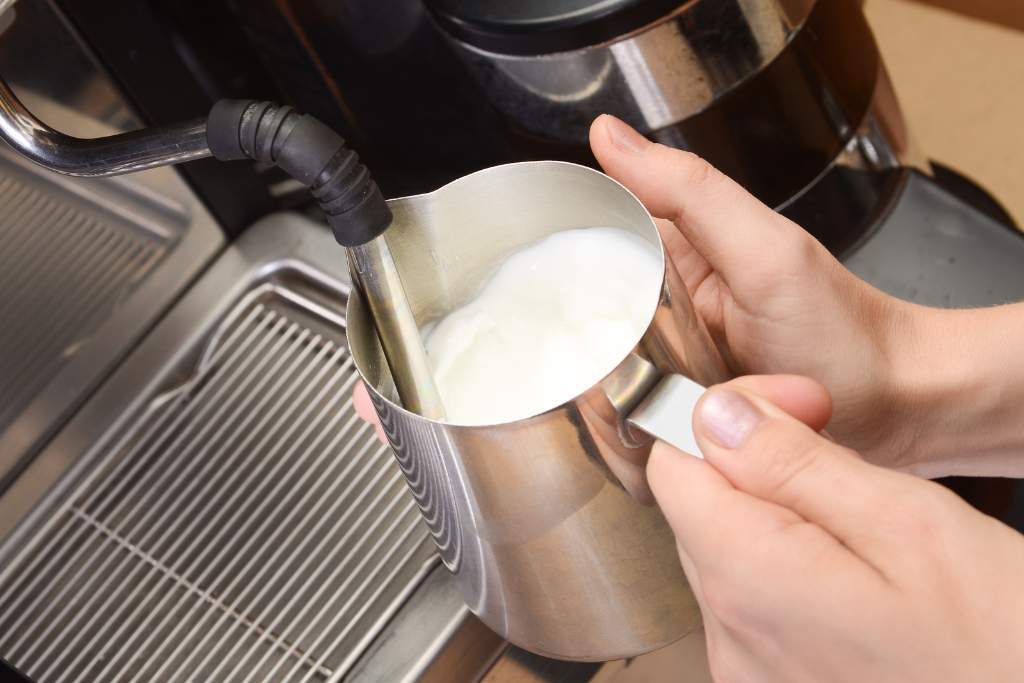
The target, in our own teaching language: it should look shiny in the jug and pour like wet paint, and feel silky on the tongue, not airy or bubbly.
The two phases
Stretching — air in. With the steam wand tip just below the surface, you introduce air. This is brief. A few seconds produces the volume you need; longer produces stiff foam that sits on top of the milk and will not pour.
The sound tells you what is happening. A light, regular tearing sound means air is going in correctly. Loud screeching means the tip is too shallow and you are making large bubbles rather than microfoam.
Texturing — rolling the milk. Dip the tip slightly deeper and angle the jug so the milk rotates in a smooth vortex. This breaks the air you introduced into progressively smaller bubbles until it becomes microfoam: glossy, paint-like, with no visible bubbles at all.
A common mistake is treating these as one continuous action. Stretch first, briefly, then sink the tip and roll.
Temperature — the number that matters
This is where most milk is ruined, and our published teaching guidance is specific about the window:
| Range | What happens |
|---|---|
| 55–65 °C | The sweet spot. Natural sugars come through and the milk develops a creamy sweetness. |
| Above 70 °C | Milk proteins break down. The result is a dull, flat taste. |
Stop at around 65 °C to keep the sweetness. The practical test without a thermometer, as experienced baristas use it: when the jug becomes almost too hot to hold, you are likely in the right zone.
Over-heated milk cannot be fixed. Once the proteins are stretched and broken they will not hold structure again. Start with fresh, cold milk.
This is also the single most common milk-frothing mistake, and it is the easiest one to eliminate, because it is a decision rather than a technique.
Do not confuse this window with the food safety temperatures further down the page. The 55 to 65 degree band is a flavour and structure target set by our teaching. The 5 degree and 60 degree figures under food safety are regulatory temperature-control points for receiving and holding food. Two entirely different things that happen to share a unit of measurement.
There is one place where temperature and water pressure become an assessed monitoring duty rather than a craft judgement, and it is the senior espresso unit, SITHFAB038, covered further down.
What good microfoam looks like
- Glossy, like wet paint, not matte
- No visible bubbles on the surface
- Holds a swirl when you rock the jug
- Pours as a single body rather than foam separating from liquid
- Feels silky, not airy, in the mouth
If foam and liquid have separated in the jug, the milk was under-textured or has been sitting. Swirl and tap the jug before pouring to blend the foam back through the liquid milk, though real separation usually means starting again.
The five mistakes that account for most bad milk
| Mistake | What goes wrong | The fix |
|---|---|---|
| Wrong wand placement | Tip too shallow for too long, producing large bubbles | Tip just below the surface to introduce air, then dip deeper to roll |
| Overheating | Above 70 °C the proteins break down and the taste flattens | Stop at around 65 °C |
| Re-using milk | Already-steamed milk will not re-texture; sweetness is gone | Fresh, cold milk from the fridge, every cup |
| Skipping the swirl | Foam and liquid pour separately | Swirl and tap before pouring |
| Treating stretch and roll as one motion | Either no volume, or stiff unpourable foam | Stretch briefly, then submerge |
Good milk cannot rescue a bad shot
Worth saying, because milk gets the blame for faults that belong upstream. The espresso has to be right as well, and the unit's knowledge evidence lists the adjustments available to you: dose, grind, tamping technique, water flow and water pressure, against quality factors that include ambient humidity, crema, espresso flow, steam pressure and taste.
Note that steam pressure is on that list of quality factors. It is the one item in it that belongs to the milk rather than to the shot, and it is the reason a machine that has been pulling shots all morning can start texturing badly without anything about your technique having changed.
Our own published benchmarks for a double shot are a run time of about 25 to 30 seconds with a flow like warm honey, a dose of 18 to 22 grams and an output of 36 to 44 grams. Under 20 seconds reads as under-extracted and sour; over 35 as over-extracted and bitter. A pale early stream usually means the grind is too coarse or the basket underfilled; stalling means too fine a grind or too high a dose; uneven flow from the spouts means the puck was not level or the water channelled.
The other causes we name for a shot that will not behave are mostly not the grinder: uneven tamping or distribution, poor water quality (filter it, descale the machine), cold equipment (heat the machine for 10 to 15 minutes, purge the group head, preheat the cups), and poor maintenance. Again, these are teaching benchmarks rather than unit requirements — what the unit requires is that you can diagnose the drift and name the variable to move. See making great coffee at home and how long does it take to become a good barista.
Practising the pour
Perfect milk is wasted if the pour is wrong. We teach it in two movements:
- Start high and steady, so the milk cuts down through the crema rather than sitting on it.
- As the cup fills, bring the jug closer and tilt it slightly, letting the microfoam rise to the surface.
Consistency comes with repetition. First attempts look like blobs rather than hearts or tulips, and that is normal. Over time you learn how jug angle, height and speed each change the outcome.
Alternative milks
Each behaves differently and none behaves quite like full cream. The unit requires knowledge of different types of milk and their characteristics for different coffee beverages, which is the formal way of saying you are expected to know how the ones your venue stocks behave rather than applying one routine to all of them.
The practical principle for non-dairy and reduced-fat milks is less air, lower temperature: the usable window is narrower than whole dairy's, and the consequences of overheating arrive sooner. Formulations vary considerably between brands, including between standard and barista-formulated versions of the same product, so the reliable approach is to texture each one you stock and learn its behaviour rather than trusting a general ranking.
This page deliberately does not rank the alternatives. That is not a gap in the article; it is that the accredited material does not rank them, and brand formulations change. What the unit does put in your hands is the customer-preference list it expects you to work from: accompaniments, blends, service-ware, strength, sweeteners, types of beans and types of milk. Milk choice is an assessed customer-preference option, not an afterthought at the till.
One related boundary, stated because it matters and because guessing would be worse. This page does not set out allergen obligations for coffee service or cross-contact duties between dairy and plant milks. Those are real questions with real legal content, and nothing in the material behind this page addresses them. Ask your local enforcement agency or your food safety program, and treat any web page that answers them confidently without citing an instrument with suspicion.
Why this matters more than latte art
Latte art is largely a by-product of correctly textured milk. Patterns such as rosettas rely on foam with a glossy, paint-like texture. Without proper microfoam, designs will not hold their shape.
So if your art is not working, the fix is almost always upstream in the texturing, not in the wrist.
Worth being clear about the credentialing position too: latte art is not separately assessed anywhere in the accredited system, including inside SITHFAB025, and there is no accredited latte art unit. Milk texturing, by contrast, is assessed. We offer latte art as an interest course, which is exactly what it is. The same goes for a "barista master class", which is a delivery format with no unit code behind it, and for coffee appreciation, which is not an accredited unit either.
There is one exception worth knowing, and it is not the art itself. Appearance and presentation are assessed — in SITHFAB038, at the level of monitoring a whole service rather than a single cup. The next section sets that out.
Equipment and hygiene
Purge the wand before use to clear condensate. Wipe it with a damp cloth immediately after every use and purge again — milk baked onto a wand is a hygiene problem and a texturing problem at the same time, and it contaminates the flavour of everything that follows.
Equipment care is inside the unit, not adjacent to it: SITHFAB025's knowledge evidence includes basic maintenance and cleaning methods for espresso equipment and essential features and functions of espresso machines and grinders.
The hygiene obligation is legal, not merely good practice. A cafe that makes and serves unpackaged food that is both potentially hazardous and ready to eat is a category one business under Standard 3.2.2A, in force since 8 December 2023. Food handlers must complete food handler training, or possess skills and knowledge commensurate with the activity, before carrying out a prescribed activity. Milk is exactly the kind of product that puts a barista in that picture — and so are ice, cut fruit and unpackaged garnishes, which is why anyone working a bar or a counter is a food handler whether or not they think of themselves as one.
The categories are activity-based, not audience-based. Category one is a caterer or food service operation that processes unpackaged potentially hazardous food into food that is both potentially hazardous and ready to eat — the legal test is whether the business performs that prescribed processing activity; having a kitchen or cooking is only a practical clue. Category two is the retail sale of ready-to-eat potentially hazardous food the business did not make, such as a deli or a butcher, where slicing, weighing, repacking, reheating and hot-holding do not count as making it. Only category one carries the records duty.
A point regularly got wrong: that training does not have to be nationally accredited, Standard 3.2.2A mandates no refresher period for it, and the business is not required to keep records of it. Note also what the alternative to training actually is — commensurate skills and knowledge, not being supervised by someone who has done the training. That older framing predates the current Standard.
Category one businesses do, however, have to keep substantiation records — including receipt at 5 °C or below or 60 °C or above, storage and display under temperature control, process steps achieving pathogen reduction, cooling and reheating within specified timeframes, transport under temperature control, and cleaning and sanitising of food-contact surfaces and equipment — for three months, accessible at the premises. A business may demonstrate compliance by other means, in which case an authorised officer may then require the records. See food handling, why food safety and handling is important and understanding Standard 3.2.2A.
The third tool under the Standard is the Food Safety Supervisor, a separate obligation from food handler training. One must be appointed before a prescribed activity begins, must remain reasonably available — on site or easily contactable — and must hold a certificate issued within the immediately preceding five years. That five-year clock belongs to the supervisor, not to food handler training, and the two are routinely confused. See food safety supervisor.
The accredited hygiene unit, SITXFSA005 Use hygienic practices for food safety, is also the prerequisite for SITHFAB025. It requires correct hand-washing, appropriate use of uniform and personal protective equipment, effective personal health and hygiene practices, and hygienic food service, each demonstrated on at least three occasions, plus the procedures for reporting unsafe hygiene practices. See virtual food handling SITXFSA005.
That prerequisite is not specific to coffee. SITXFSA005 is the gateway unit for the whole food and beverage stream:
| Unit | Prerequisite(s) |
|---|---|
SITHFAB021 Provide responsible service of alcohol |
— |
SITHFAB022 Clean and tidy bar areas |
SITXFSA005 |
SITHFAB023 Operate a bar |
SITXFSA005 and RSA SITHFAB021 |
SITHFAB024 Prepare and serve non-alcoholic beverages |
SITXFSA005 |
SITHFAB025 Prepare and serve espresso coffee |
SITXFSA005 |
SITHFAB026 Provide room service |
SITXFSA005 |
SITHFAB027 Serve food and beverage |
SITXFSA005 |
SITHFAB030 Prepare and serve cocktails |
SITXFSA005, RSA SITHFAB021 and SITHFAB023 |
SITHFAB034 Provide table service of food and beverage |
SITXFSA005 and RSA SITHFAB021 |
SITHFAB035 Provide silver service |
SITXFSA005 |
SITHFAB038 Plan and monitor espresso coffee service |
— |
Nine units off one, so SITXFSA005 is the unit to schedule first. Keep that figure scoped to the food and beverage stream, because across the wider SIT package the same unit also sits in front of cookery, patisserie and kitchen units, which would be a different total about a different set. RSA reaches just as far inside the stream: SITHFAB021 is a prerequisite to nine units of its own, so the licensing unit gates exactly as many as the food safety unit does.
Four units in the stream carry two or more prerequisites. SITHFAB023 Operate a bar and SITHFAB034 Provide table service of food and beverage each carry two, both requiring SITXFSA005 and RSA SITHFAB021; SITHFAB030 Prepare and serve cocktails carries three, adding SITHFAB023; and SITHFAB039 Manage the sale or service of wine carries three of its own in SITHFAB021, SITHFAB032 and SITHFAB033. For SITHFAB034 the register explains why: it covers the higher-order techniques of a senior food and beverage attendant, where SITHFAB027 covers fundamentals for casual dining, and the difference shows up as an added alcohol-service prerequisite — which applies whether or not the venue is licensed.
Four units in the stream have no prerequisites at all: SITHFAB021, SITHFAB028, SITHFAB036 and SITHFAB038.
Where milk texturing sits in the assessed standard
SITHFAB025 requires you to prepare ten named espresso beverages, each on three separate occasions, within commercial timeframes. Only three of the ten are made without milk:
| Involves milk | Made without milk |
|---|---|
| Caffe latte | Espresso (short black) |
| Cappuccino | Long black |
| Flat white | Ristretto |
| Piccolo latte | |
| Mocha | |
| Short macchiato | |
| Long macchiato |
Seven of the ten, then — and because each of the ten is required on three occasions, that is 21 of the 30 minimum preparations. Put numerically, seven-tenths of the assessed volume of the national espresso unit passes through a milk jug.
That grouping is a reading of the beverage list rather than a classification the unit itself makes — the unit names the ten and does not sort them — but the practical consequence holds either way: milk is the limiting factor on most of the assessment, which is why it deserves disproportionate practice. A candidate whose texturing is inconsistent will not finish thirty preparations to consistent quality within commercial timeframes, no matter how good the espresso is. Failing on milk is not failing one beverage; it is failing seven, three times each.
SITHFAB025 sets no minimum number of service periods, which is worth knowing because its neighbours do: SITHFAB024 requires three including one peak, SITHFAB027 five, SITHFAB034 twelve and SITHFAB038 six. If a provider tells you the espresso unit needs a set number of shifts, that requirement is not in the unit.
Monitoring milk quality is its own unit: SITHFAB038
Everything above is about producing one good jug. There is a separate accredited unit about keeping the milk and the coffee consistent across a whole trading period, and it is the natural next step for anyone who has stopped worrying about their own pour and started worrying about everyone else's.
SITHFAB038 Plan and monitor espresso coffee service is current on our scope as RTO 3722 at extent Deliver and assess to 30 June 2032. Its four elements are:
| Element | What it covers |
|---|---|
| 1. Plan coffee beverage service | Develop coffee beverage menus, select suppliers and roasters, liaise with suppliers to hold quality standards |
| 2. Provide specialist advice on espresso coffee beverages | Develop and update your own knowledge, answer customer questions, give accurate information to staff, promote coffee appreciation |
| 3. Monitor quality of coffee beverages | Identify the characteristics of superior espresso, evaluate bean freshness, monitor grind and dose consistency, assess beverage quality |
| 4. Monitor and maintain equipment | Monitor machines and equipment for efficiency, monitor temperature and water pressure, develop environmentally sound practices, schedule service calls |
Two of those elements land directly on the subject of this page. Element 4 makes monitoring temperature and water pressure an assessed duty, which is the systematic version of the steam-pressure problem noted earlier — not a judgement made cup by cup but a condition watched across a service. Element 2 makes giving accurate information to staff assessable, which is what teaching a junior to texture actually is.
Its performance evidence requires the candidate to coordinate the operational aspects of espresso coffee preparation for an outlet across at least six service periods, to maintain commercial grade espresso machines and grinders throughout each of those six, and to monitor the consistency and quality of eight named characteristics throughout service:
| # | Characteristic |
|---|---|
| 1 | Appearance, including opacity or transparency |
| 2 | Aroma |
| 3 | Colour |
| 4 | Flavour |
| 5 | Freshness |
| 6 | Presentation |
| 7 | Taste |
| 8 | Volume |
That is the accredited vocabulary for judging a cup, and it is the only place in the espresso stream where appearance and presentation are assessed at all. Note what is not on it: latte art, still, even here. What is assessed is whether the cup looks consistent with the others, not whether it carries a pattern.
And one structural quirk: SITHFAB038 has no prerequisite units at all — not SITXFSA005, and not SITHFAB025. The entry-level espresso unit is gated and the senior one is not, which means an experienced head barista can be assessed in the monitoring unit directly. The contrast in how the two are measured is the clearest statement of what separates them: SITHFAB025 counts beverages and occasions, because making a drink is assessed per drink; SITHFAB038 counts service periods, because consistency can only be assessed across a service.
Beyond espresso: where else textured and heated milk appears
A cafe counter sells more than coffee, and the neighbouring unit covers the rest of it. SITHFAB024 Prepare and serve non-alcoholic beverages requires at least six different beverages from a defined list — carbonated drinks, non-espresso coffees, frappés, freshly squeezed juices, hot chocolate, iced chocolate or coffee, milkshakes, mocktails, smoothies and teas — each on three occasions, across at least three service periods including one peak, using correct equipment, ingredients and standard measures.
Several of those are milk drinks, which means the texturing and heating judgement on this page transfers directly. Between SITHFAB024 and SITHFAB025 you have most of what a counter actually sells, and both carry the same food safety prerequisite.
The skill set that packages the espresso side is SITSS00080 Espresso Machine Operation: SITHFAB025, SITXCCS014 Provide service to customers, SITXFIN007 Process financial transactions and SITXFSA005. Its target group is espresso machine operators in cafes, restaurants, bars, clubs, and function and event venues; it provides credit toward SIT Training Package qualifications; and no occupational licensing, certification or legislative requirement applies to it — there is no barista licence in Australia. The advisory counterpart is SITSS00075 Beverage Advice.
SITHFAB025 is not core to any of our qualifications. It appears as a Group B (Food and Beverage) elective in SIT30622 Certificate III in Hospitality and as an elective in SIT30722 Certificate III in Hospitality (Restaurant Front of House), and SIT30722 carries SITXFSA005 and SITHFAB021 as core, so a learner in that qualification has already cleared the two prerequisites that stand in front of most of the stream — though not SITHFAB030, which also needs SITHFAB023, or SITHFAB039, which also needs SITHFAB032 and SITHFAB033. For scale, our scope of registration carries 17 current qualifications, 81 current skill sets and 579 current units, all at the extent Deliver and assess. See SIT30622 and SIT30722.
On the provider's own identity, the Australian Business Register records seven current registered business names for the legal entity COMPLETE HOSPITALITY TRAINING (VIC.) PTY. LTD., ABN 27 006 947 262 — COMPLETE HOSPITALITY TRAINING, THE COFFEE SCHOOL, Coffee School by CHT, Melbourne Barista, Victorian Bar School, Ready Serve Achieve Melbourne and Alchemy Institute of Australia. Three of the seven are coffee names, so a reader who encounters any of them is dealing with RTO 3722. An earlier version of this page said five. Those registration dates are facts about business-name registration, not about when coffee training began.
Where to learn it properly
Texturing needs repetitions, which means machine time. When comparing courses, ask how much hands-on machine time you personally get rather than how many days the course runs — and, given that seven of the ten assessed beverages take milk, ask specifically how much of that time is on the jug rather than the group head.
If you have already been doing this commercially, the first conversation is about recognition rather than enrolment. Recognition of prior learning must be offered under Standard 1.6 of the Outcome Standards for RTOs and is a genuine assessment against the same evidence requirements, not a waiver. Credit transfer under Standard 1.7 applies instead where you already hold a whole unit from any RTO, with no reassessment. Both are raised at the pre-training review, required under Standard 2.2 of the Outcome Standards for RTOs. For nationally recognised training, a Unique Student Identifier (USI) is generally required before a qualification or Statement of Attainment can be issued, unless an applicable exemption applies. See the official USI exemption guidance. A USI is free at usi.gov.au. If you already have one, recover it rather than creating another. We first verify the evidence and equivalence, check that the units fit your training product, and check for licensing or regulatory restrictions before granting credit. See ASQA’s credit-transfer guidance.
See barista coffee course, accredited barista training in Sydney NSW, barista master class, what are the benefits of doing barista training and education, how much experience does a barista need, skills assessment and contact.
About us
We are Complete Hospitality Training, RTO 3722, CRICOS 04242E. Level 3, 28 Elizabeth Street, Melbourne VIC 3000, and 410 Elizabeth Street, Surry Hills NSW 2010. Contact melbourne@cht.edu.au or +61 3 9654 1554. The legal entity is COMPLETE HOSPITALITY TRAINING (VIC.) PTY. LTD., ABN 27 006 947 262, ACN 006 947 262.
We link to the relevant course and regulatory sources in this guide. Check those sources for current requirements, and confirm course availability, delivery, fees and entry requirements with us before enrolling.
Source records and further guidance
We link the unit records and regulator guidance relevant to this page below. Check the current source before making an enrolment, licensing or employment decision.
- SITXFSA005 Use hygienic practices for food safety
- SITHFAB025 Prepare and serve espresso coffee
- SITHFAB038 Plan and monitor espresso coffee service
- SITHFAB021 Provide responsible service of alcohol
- SITHFAB023 Operate a bar
- Food Standards Code — Standards 3.2.2 and 3.2.2A (food safety practices and food safety management tools)
- Outcome Standards for Registered Training Organisations 2025 (full text)
- Unique Student Identifier (USI) requirements for RTOs
What temperature should milk be for coffee?
We teach a sweet spot of 55 to 65 °C. Above 70 °C the milk proteins break down and the taste goes flat. That is teaching guidance, not a figure written into the unit.
How do I judge temperature without a thermometer?
By touch: when the jug becomes almost too hot to hold, you are likely in the right zone. A thermometer is more reliable while you are learning.
Is the 55 to 65 degree window a food safety rule?
No, and the two should not be mixed up. It is a flavour and structure target. The regulatory temperature-control figures for food are separate — receipt at 5 °C or below, or 60 °C or above, for a category one business's substantiation records.
Is monitoring temperature ever an assessed requirement?
Yes, in SITHFAB038 Plan and monitor espresso coffee service. Its fourth element requires monitoring espresso machines and equipment for efficiency and monitoring temperature and water pressure across at least six service periods.
Why is my foam bubbly?
Too much air, or the tip held too shallow for too long. Stretch briefly, then sink the tip and roll the milk. Swirling afterwards helps blend out stray bubbles.
Why will my milk not pour?
Usually over-heated, or over-stretched into stiff foam that has separated from the liquid.
Can I re-steam or re-froth milk?
No. Once steamed, the proteins are already stretched and will not hold structure again, and the sweetness is gone. Use fresh, cold milk for every cup.
What exactly is microfoam?
An emulsion of air and milk proteins, where the proteins hold the bubbles small and uniform. It should look shiny in the jug, pour like wet paint and feel silky rather than airy.
My milk was fine yesterday and is poor today. What changed?
Check steam pressure before you change your technique. Steam pressure is one of the quality factors SITHFAB025 names, and monitoring it is an assessed duty in SITHFAB038. Ambient humidity is also on the unit's list, and it moves the grind rather than the milk.
My milk is fine but the coffee still tastes wrong. What now?
Look upstream at extraction. Our teaching benchmarks are roughly 25 to 30 seconds for a double shot, 18 to 22 grams in, 36 to 44 grams out — with a pale early stream pointing to too coarse a grind, stalling to too fine, and uneven flow to channelling. Water quality, cold equipment and maintenance account for a surprising share of faults blamed on the grinder.
Is latte art possible without good microfoam?
Not really. Patterns rely on glossy, paint-like foam to hold their shape. Fix the texturing and the art becomes achievable.
Is latte art assessed in the accredited unit?
No. Latte art is not part of SITHFAB025's performance or knowledge evidence, and there is no accredited latte art unit. Milk texturing is assessed.
Is how the cup looks assessed anywhere?
Yes, but not as art. SITHFAB038 requires monitoring eight named characteristics through service, including appearance, including opacity or transparency, presentation and colour — judged for consistency across a service rather than on one cup.
Which alternative milk textures best?
This page will not name one. The unit requires knowledge of the characteristics of different milks but does not rank them, and formulations differ by brand. The general principle is less air and lower temperature than whole dairy, and the reliable method is to learn the behaviour of each milk your venue stocks.
Is milk choice part of the assessment?
Yes, as a customer preference. The unit names accompaniments, blends, service-ware, strength, sweeteners, types of beans and types of milk as the customer-preference options a candidate works with.
What are my allergen duties when handling plant milks?
This page does not answer that, because nothing in the source material behind it addresses allergen law or cross-contact duties for coffee service. Take it to your local enforcement agency or your food safety program rather than to a web page.
How much of the espresso unit depends on milk?
Seven of the ten named beverages involve milk — only espresso, long black and ristretto do not — so 21 of the 30 minimum preparations are gated on it.
Does SITHFAB025 require service periods?
No. It is the only unit in the beverage stream with no service-period requirement. SITHFAB024 needs three including a peak, SITHFAB027 five, SITHFAB038 six and SITHFAB034 twelve.
Do I need SITHFAB025 before SITHFAB038?
No. SITHFAB038 has no prerequisite units at all, which makes it the unusual case of the senior unit being less gated than the entry-level one.
Does SITHFAB023 Operate a bar have prerequisites?
Yes — two: SITXFSA005 and RSA SITHFAB021. Within the food and beverage stream SITXFSA005 gates nine units — SITHFAB022, SITHFAB023, SITHFAB024, SITHFAB025, SITHFAB026, SITHFAB027, SITHFAB030, SITHFAB034 and SITHFAB035 — and four units carry two or more prerequisites: SITHFAB023 and SITHFAB034 carry two, SITHFAB030 and SITHFAB039 carry three. The four with none at all are SITHFAB021, SITHFAB028, SITHFAB036 and SITHFAB038.
Do I have to purge the steam wand every time?
Yes — before use to clear condensate, and immediately after use, together with wiping it down. Dried milk on a wand is both a hygiene failure and a flavour problem.
Am I legally a food handler if I only make coffee?
If you are handling milk in a business that makes and serves unpackaged potentially hazardous ready-to-eat food, yes. Food handler training, or commensurate skills and knowledge, is required before carrying out a prescribed activity. Handling ice, cut fruit or unpackaged garnishes puts you in the same position.
Does my food handler training need to be renewed?
Standard 3.2.2A mandates no refresher period. The five-year renewal cycle belongs to the separate Food Safety Supervisor certificate.
Do I need a licence to work as a barista?
No. The SITSS00080 skill set record states that no occupational licensing, certification or legislative requirement applies to it.
Images on This Page
-
https://cht.edu.au/wp-content/uploads/2022/04/cht_logo_web_land.svg
logo
-
data:image/svg+xml,%3Csvg%20xmlns='http://www.w3.org/2000/svg'%20viewBox='0%200%200%200'%3E%3C/svg%3E
logo
-
https://cht.edu.au/wp-content/uploads/2022/04/cht_logomark_webb.png
logo
-
https://cht.edu.au/wp-content/uploads/2022/04/cht_logo_rgb.svg
logo
-
https://cht.edu.au/wp-content/uploads/2020/11/banner_coffee-beans.jpg
(no alt text)
-
https://cht.edu.au/wp-content/uploads/2025/10/Milk-Texturing-101-Microfoam_-Temperature_-and-Common-Mistakes.jpg
Barista steaming milk with a stainless steel jug, positioning the steam wand tip just below the surface to create smooth, glossy microfoam for coffee.
-
data:image/svg+xml,%3Csvg%20xmlns='http://www.w3.org/2000/svg'%20viewBox='0%200%201200%20800'%3E%3C/svg%3E
(no alt text)
-
https://cht.edu.au/wp-content/uploads/2020/08/AdobeStock_139998652b-e1604277396692.jpg
(no alt text)
-
https://cht.edu.au/wp-content/uploads/2020/08/AdobeStock_108943277-e1604277362634.jpg
(no alt text)
-
https://cht.edu.au/wp-content/uploads/2020/08/AdobeStock_202644171-e1604277433640.jpg
(no alt text)
-
https://cht.edu.au/wp-content/uploads/2020/08/AdobeStock_172629488-e1604277467697.jpg
(no alt text)
-
data:image/svg+xml,%3Csvg%20xmlns='http://www.w3.org/2000/svg'%20viewBox='0%200%2030%200'%3E%3C/svg%3E
nationally
-
https://cht.edu.au/wp-content/uploads/2024/08/nationally.svg
nationally
-
data:image/svg+xml,%3Csvg%20xmlns='http://www.w3.org/2000/svg'%20viewBox='0%200%2040%200'%3E%3C/svg%3E
nationally
-
https://cht.edu.au/wp-content/uploads/2024/08/quality.svg
nationally
-
data:image/svg+xml,%3Csvg%20xmlns='http://www.w3.org/2000/svg'%20viewBox='0%200%2045%200'%3E%3C/svg%3E
nationally
-
https://cht.edu.au/wp-content/uploads/2024/08/art.svg
nationally
-
https://cht.edu.au/wp-content/uploads/2024/08/established.svg
nationally
-
https://cht.edu.au/wp-content/uploads/2024/08/service.svg
nationally
-
data:image/svg+xml,%3Csvg%20xmlns='http://www.w3.org/2000/svg'%20viewBox='0%200%201%201'%3E%3C/svg%3E
(no alt text)
-
https://cht.edu.au/wp-content/uploads/2022/04/cht_logo_wht.svg
(no alt text)
-
data:image/svg+xml,%3Csvg%20xmlns='http://www.w3.org/2000/svg'%20viewBox='0%200%2032%2032'%3E%3C/svg%3E
Facebook
-
https://cht.edu.au/wp-content/uploads/2023/02/facebook.svg
Facebook
-
https://cht.edu.au/wp-content/uploads/2023/02/instagram.svg
Instagram
-
https://cht.edu.au/wp-content/uploads/2023/02/youtube.svg
YouTube
-
https://cht.edu.au/wp-content/uploads/2023/02/tiktok.svg
TikTok
-
https://cht.edu.au/wp-content/uploads/2023/02/linkedin.svg
LinkedIn
-
data:image/svg+xml,%3Csvg%20xmlns='http://www.w3.org/2000/svg'%20viewBox='0%200%20404%2074'%3E%3C/svg%3E
(no alt text)
-
https://cht.edu.au/wp-content/uploads/2023/12/flags.png
(no alt text)
-
https://cht.edu.au/wp-content/themes/cht/images/close-icon.png
(no alt text)