Bartender Interview Questions & Trial-Shift Tips
Bar interviews are short, and most of them end in a trial shift rather than a conversation. Preparing for the trial matters more than preparing answers.
That said, two or three questions do decide the outcome, and one of them has a right answer that comes straight out of the assessment requirements for the RSA unit. If you know what the unit actually asks you to demonstrate, you know what a good answer sounds like.
The question that comes first
"Do you have your RSA?"
This is a screening question, not an interview question. You need it to serve alcohol in a licensed venue, so a no usually ends the process.
What a good answer includes: the state it was issued in, and how current it is. Those two facts are the whole answer, because the rules differ by jurisdiction.
| Jurisdiction | The answer they want |
|---|---|
| New South Wales | Eligible temporary interstate workers can use approved interstate RSA. Permanent movers and security or RSA marshal roles must meet NSW training and competency-card requirements; eligible holders can use bridging instead of the full NSW RSA course. NSW competency card: five years. Interstate concessions have separate eligibility and certificate-age requirements. |
| Victoria | Use a current Victorian RSA certificate. Eligible interstate holders can apply for free bridging: approved original training within three years, with the online-course residence condition. Specific exemptions apply at qualifying producer events. Victorian RSA Refresher every three years. |
| Queensland | Accepted where the evidence is a Statement of Attainment for the nationally accredited Provide Responsible Service of Alcohol course. An attendance certificate is insufficient. Valid RSA training generally has no expiry; training completed before 2002 must be replaced. |
| Western Australia | Provide the RSA certificate showing completion of the nationally accredited course. An interstate RSA card alone is not accepted as evidence. Keep the RSA certificate as training evidence; approved-manager cards have separate renewal requirements. |
| South Australia | Check provider approval and training date. Training from 1 November 2020 must be through a Commissioner-approved RTO. Earlier RSA training need not be repeated solely because of that approval change. No routine RSA renewal period stated in the cited CBS guidance; check applicable licence conditions. |
| Tasmania | Interstate certificates can be accepted under the Commissioner’s conditions. Requirements differ for employees and liquor licence holders; check the appropriate role. No RSA expiry date in the regulator’s FAQ; an employer may request updated training. |
| Northern Territory | Certificates from an RTO registered to deliver RSA are accepted, including interstate certificates. Check certificate age and the NT refresher requirements. NT guidance gives a three-year limit for interstate certificates and directs holders to a refresher; check current renewal guidance. |
| Australian Capital Territory | Valid interstate RSA certificates are recognised, subject to the ACT’s three-year currency limit and ACT-approved refresher requirements. Three years from course completion, then an ACT-approved refresher. |
Current regulator guidance: NSW, VIC, SA, QLD, WA, NT, ACT, TAS.
A specific tip for Victoria: if you finished a course but never completed the LCV Learning Hub stage — the pre-training survey, the Sexual Harassment and Assault: Recognise, Prevent and Respond module and the post-training survey — you do not yet hold a Victorian RSA certificate. Sort that out before the interview, not after. A manager who has been through this before will ask which document you have.
An RSA Statement of Attainment is a national training record, but permission to serve alcohol depends on the destination’s rules. NSW permits eligible temporary interstate workers; permanent movers and security or RSA marshal roles must meet NSW training and competency-card requirements, using bridging where eligible. Victoria offers bridging to eligible interstate holders. SA applies approved-provider rules to training from 1 November 2020, with earlier training not required to be repeated solely for that change. QLD and WA require suitable national RSA evidence. Tasmania distinguishes staff from licence holders; the ACT and NT have local currency and refresher requirements. Check the regulator before your first shift. See RSA recognition by jurisdiction, NSW’s rules and SA’s rules. See how long does an RSA last.
The question that actually decides it
"What would you do with an intoxicated customer?"
This is the most important question in a bar interview and the one candidates most often answer badly. It is also the one where you can answer better than almost everyone else, because the RSA unit spells out exactly what competence looks like.
A strong answer covers the sequence:
- Refuse early, at the point where signs first appear, rather than waiting until it is a scene
- Do it quietly, beside the person rather than across the bar
- Keep it brief and non-negotiable, and state the reason — the unit requires you to refuse professionally and give a reason
- Offer assistance. The unit names three kinds: connecting the customer with their designated driver or companions, offering alternatives to alcohol including food or non-alcoholic drinks, and organising or providing transport information for someone who wants to leave. Naming those three rather than saying "offer them water" is the single cheapest way to sound trained
- Tell the team, so a friend cannot buy on their behalf. Secondary supply is how most refusals get defeated
- Escalate to security if it turns, rather than managing it physically yourself
What will genuinely distinguish you is naming the three categories the unit singles out, because most candidates talk about one generic drunk person. SITHFAB021 requires you to have a procedure for refusing service to, and assisting:
- customers in emotional or physical distress
- customers with no food consumption during extended service of alcohol
- customers who appear to be under the effect of illicit substances or other drugs
Say that those three need different responses, and that the second one is the reason food and water matter rather than being a courtesy, and you will sound like someone who has been trained rather than someone who has watched a lot of shifts.
The unit also asks you to name at least three early indicators of intoxication and to have intervention strategies to prevent intoxication — slowing service, food, water, standard measures. Prevention is the part interviewers rarely hear and always like.
The answer almost nobody gives is about ordering behaviour rather than appearance. The unit's performance criterion 2.3 is to identify erratic drinking patterns as an early sign of possible intoxication and take appropriate action, and it names the patterns: mixing a wide range of drink types, drinking quickly and in quick succession, ordering more than one drink for their own consumption, consistently returning to request more samples, ordering multiple or large samples, and ordering "triple shots" or extra-large drinks. Every one of those is visible from behind the bar before any of the speech, balance or appearance signs appear. Mention two of them and you have answered a level above the field.
On liability, say it plainly but accurately: supplying alcohol to an intoxicated person is an offence under liquor law, and liability can attach to the individual serving as well as to the venue. The specific offence and penalty are set by each state. That answer tells a manager you will not be a problem for their licence. See managing intoxicated patrons.
The other questions that get asked
"Talk me through making a [classic]." They are testing method and confidence, not artistry. Answer in sequence: glass, ice, build or shake, garnish. If you do not know it, say so and say how you would find out. Guessing badly is worse than not knowing.
Worth knowing that the accredited cocktail unit, SITHFAB030, is built on six methods — blended, built, floated, muddled, shaken, stirred — and requires two different cocktails by each across three service periods. If you can say which method a given drink uses and why, you are answering at the level the qualification expects.
"How do you handle a rush?" They want sequencing, not heroics. Group similar drinks, keep the station clean, communicate with the floor. The accredited unit for running a bar requires at least one peak service period in its assessment, and it names mise en place as knowledge evidence, so the honest answer is that a rush is mostly won before it starts.
"Have you worked a function before?" If you have, name the arrangement. SITHFAB023 Operate a bar names the types of bar service you are expected to know: cash drinks, dry till, inclusive packages, open bar, pre-set drinks, set limits. Knowing that a dry till and an open bar with a set limit are different problems is a genuine mark of experience and is almost never mentioned by candidates.
"What is your availability?" Be honest. Most bar roles are casual and evening-and-weekend weighted. Overstating availability and then declining shifts is the fastest way to stop being rostered.
"Why this venue?" Have been there, or at least looked at what they sell. A cocktail bar and a sports pub want different things, and a wine bar wants something different again.
"Do you have food handling?" Often asked, because bar staff handling ice, cut fruit or unpackaged garnishes are food handlers. It is also structural rather than a preference: SITXFSA005 Use hygienic practices for food safety is a formal prerequisite to SITHFAB023 Operate a bar, alongside RSA itself, and to the non-alcoholic beverage and espresso units. So a venue asking the question is asking about the same unit the training package already requires before you can be assessed on running a bar. Say yes if you do, and if you do not, know that food handler training under Standard 3.2.2A does not have to be accredited. See the food handling course.
Four questions from our original interview guide
The source guide asks more than whether you hold an RSA. For a difficult customer, describe listening calmly, checking what can be resolved and involving a manager when needed; do not promise to keep serving someone who should be refused alcohol. For responsible service, explain how you check identification, watch for intoxication and refuse service politely when required. For speed without losing quality, describe preparation, a clean station, a known menu and asking the team for help in a rush. For what you enjoy about bartending, give a truthful example that joins care for guests with interest in the craft. A strong answer is specific to work you have actually done or practised, rather than a rehearsed claim of experience you do not have.
The trial shift
This is the real interview.
- Arrive early, in black, in non-slip closed-toe shoes
- Ask where things are rather than guessing. Nobody minds questions on a first shift
- Work clean. Wiping down and clearing as you go is noticed more than speed
- Watch their method and copy it. Every bar builds drinks slightly differently and they want theirs. The accredited unit is assessed against organisational procedures and the venue's own standard recipes, which is the same instinct
- Handle glass and ice properly. You are a food handler at that moment
- Do not sit down, and do not spend the shift on your phone
- Do the handover. At the end, tell someone what is low on stock, what broke, and which customers were a problem. That is literally what the unit's handover requirement covers, and almost no trialist does it
A competent, tidy, unflustered trial beats a flashy one. Nothing in any assessment requirement mentions flair.
What to bring
- RSA — the card in NSW, the Certificate of Completion in Victoria, the Statement of Attainment elsewhere
- Food handling, if you have it
- Any nationally recognised Statements of Attainment. If your training carried a unit code such as
SITHFAB021,SITHFAB023orSITHFAB030, that is checkable and worth mentioning. A real Statement of Attainment carries the RTO's name, registration code and logo, the full title and national code of each unit, the NRT logo, an authorised signature and a seal or watermark. A certificate of attendance from a non-accredited course has none of those and a manager who knows the industry can tell - Your USI, if you are likely to be enrolled in anything through the venue
See the essential bartender's toolkit.
Questions worth asking them
Which award covers the venue. This is decided by the premises, not the job title, and there are four possible answers rather than two. Each award covers its industry to the exclusion of any other modern award, so exactly one applies.
| Award | Code | Premises |
|---|---|---|
| Hospitality Industry (General) | MA000009 |
Hotels, motels, pubs, taverns, wine bars, resorts, casinos, caterers, accommodation, function facilities |
| Registered and Licensed Clubs | MA000058 |
Not-for-profit registered clubs — RSL, bowls, golf, surf, sporting, community |
| Restaurant Industry | MA000119 |
Standalone restaurants, cafes, bistros, night clubs, reception centres, roadhouses |
| Fast Food Industry | MA000003 |
Takeaway, food courts, food sold mainly to be eaten away from the counter |
The two traps: clubs are not MA000009 — clause 4.4(d)(i) of that award expressly excludes "clubs registered or recognised under State or Territory legislation" — and night clubs are not MA000058, because a night club is commercial rather than not-for-profit.
The other things worth asking:
- What classification level you would start at. This is the question that actually moves your pay. Under
MA000009,MA000119andMA000058alike, a relevant AQF Certificate III or higher, used at work, sets a minimum classification of Level 4 — and inMA000009andMA000119Level 4 is the reference point for the whole structure. The fast food awardMA000003has no equivalent provision. Note thatMA000009andMA000119(clause 18.1) require you to make use of the skills derived from those competencies, andMA000058(clause 18.3) adds that the Fair Work Commission may require you to demonstrate that you utilise them. The Introductory level cap — three months, extendable by mutual agreement for a further three — is aMA000009provision, so ask which award first - Whether a qualification is the only route to that level. It is not, and this is worth knowing before you undersell yourself. The awards define an "appropriate level of training" three ways: completing a training program that meets the training and assessment requirements of a qualification or one or more appropriate units of competency from a training package; or being assessed by a qualified skills assessor as having at least equivalent skills; or, as at a specified date, having been doing the work of that classification for at least three months. Units count, not only whole qualifications
- The roster pattern, and how shifts are allocated. Rostering and notice-of-change provisions are set by the award that applies to the venue, and they differ between the four awards above, so the useful question is which award applies and then what that award's rostering clause says. The Fair Work Ombudsman publishes each award in full. Do not accept a single national figure from anyone, this page included
- Whether they need food handling as well
- Who is trained on the gas. Beer and post-mix systems use inert gases with real asphyxiation risk, and
SITHFAB023names AS5034 and the control of access to restricted areas containing that equipment. It is a fair question and a good venue answers it immediately
Asking about the award signals you know how you should be paid. That is not a rude question, and it tends to be taken as a sign of seriousness rather than suspicion. No dollar rates appear on this page: award rates re-set every 1 July, so use the Fair Work Ombudsman's Pay and Conditions Tool with the right award code.
About us
We are Complete Hospitality Training, RTO 3722, CRICOS 04242E. Level 3, 28 Elizabeth Street, Melbourne VIC 3000, and 410 Elizabeth Street, Surry Hills NSW 2010. Contact melbourne@cht.edu.au or +61 3 9654 1554.
See the RSA page and the bartending course.
We link to the relevant course and regulatory sources in this guide. Check those sources for current requirements, and confirm course availability, delivery, fees and entry requirements with us before enrolling.
Do I need experience?
Many venues hire trained beginners and build speed on the job. Neither Certificate III in Hospitality has entry requirements either, so the training route is open regardless of experience.
What if I do not know a drink?
Say so, and say how you would check. Confidence with a wrong build is worse than an honest gap, and a bar with written standard recipes expects you to use them.
Are trial shifts paid?
Work performed generally must be paid. Check with the Fair Work Ombudsman (https://www.fairwork.gov.au/) if a venue suggests otherwise.
How much notice of my roster should I get?
That depends on the award covering the venue, and the four awards that can apply to bar work do not answer it identically. Find out which award applies, then read its rostering clause on the Fair Work Ombudsman's site. We do not publish a single figure here because there is no single figure that is correct across all four.
What if they classify me below Level 4 and I hold a Certificate III?
Raise it with the employer first, then use the award's own dispute procedure. The route differs by award: MA000009 clause 40, MA000119 clause 34, and under MA000058 referral to the Fair Work Commission. Be ready to say which Certificate III competencies the role draws on, because MA000009 and MA000119 turn on whether you make use of them and MA000058 allows the Commission to require you to demonstrate that you do.
The job is at an RSL. Does that change anything?
The award does. An RSL is a not-for-profit registered club, so it sits under MA000058, not the hospitality award, and MA000058 has its own classification structure and pay table. What does not change is the qualification floor: MA000058 carries the same Level 4 minimum classification for a relevant AQF Certificate III used at work, so the argument for finishing a qualification is just as strong there. The RSA requirement is unchanged too — that is set by your state's liquor regulator, not by the award.
What about a night club?
MA000119 Restaurant Industry Award, counter-intuitively. A night club is a commercial venue rather than a registered not-for-profit club. It also carries the Level 4 qualification floor.
I have a Certificate III. Is it worth raising at interview?
Yes, and be specific about using it. Under MA000009, MA000119 and MA000058, a relevant AQF Certificate III or higher used at work sets a minimum classification of Level 4. The wording in MA000009 and MA000119 turns on whether you make use of the skills, so saying which of those competencies the role will draw on is a stronger move than simply naming the certificate.
I have units but not a full qualification. Does that count?
It can. The "appropriate level of training" definition covers a training program meeting the requirements of a qualification or one or more appropriate units of competency from a training package, and it also covers assessment by a qualified skills assessor as having equivalent skills. Bring the Statements of Attainment and name the unit codes.
I am 19. Will I be on a junior rate?
Not as a liquor service employee under MA000009. Clause 13.5 requires a junior employee working as a liquor service employee to be paid as an adult at the classification rate for the work performed, rather than the reduced junior percentage that would otherwise apply. If the venue is a club or a night club, check the equivalent provision in that award.
Can I work behind a bar if I am under 18?
It depends entirely on the state, and the rules are different kinds of rule rather than one national age. Queensland sets no minimum age under the Liquor Act 1992, and under-18s may serve alcohol in hotels, restaurants and cafes where the venue holds no adult entertainment permit. Western Australia instead penalises a licensee who employs a juvenile to sell, supply or serve alcohol, with a $10,000 penalty under the Liquor Control Act 1988. In Victoria, LCV states you may complete the RSA training under 18 but must be 18 to serve alcohol. Ask your own regulator rather than assuming any of these applies to you.
The venue says I can start before my RSA arrives. Is that right?
It might be, depending on where you are. Victoria allows completion before you start supplying alcohol or within one month of first supplying it, Queensland allows 30 days from starting employment, Western Australia 28 days with a copy to the employer. Other jurisdictions publish no grace period. Do not rely on one you have not confirmed, and note that in Victoria the licensee is separately required under s 108AB of the Liquor Control Reform Act 1998 to ensure you have completed an approved program, and under s 108AD to keep your certificate on the premises.
Should I mention that I am studying?
Yes. A qualification in progress signals you intend to stay in the industry, and it has a pay consequence once completed and used at work. If you are employed as a trainee, there is a further entitlement worth knowing: a trainee is entitled to be released from work without loss of pay and without loss of continuity of employment to attend the training and assessment specified in the training contract, and that time counts as time worked. Traineeships are also structured around 20% of ordinary hours being approved training.
What do I wear to a trial?
Black, plain, and non-slip closed-toe shoes. A bar has ice, water, a glasswasher and a mop bucket in it.
How do I answer "what are your weaknesses" for a bar job?
Name a real one with a mitigation, preferably operational rather than characterological. Slow on unfamiliar cocktails but quick to check the recipe spec is a better answer than perfectionism.
They asked me to name three signs someone has had enough. What are they after?
Behavioural change rather than a fixed list. Speech, balance and coordination, behaviour and appearance are the four areas, and what matters is change against that person's own baseline across the session. The unit requires at least three early indicators, so the good answer is about spotting it early rather than cataloguing severe intoxication. If you want to answer a level up, add the ordering-behaviour patterns from performance criterion 2.3.
Is there any point mentioning a cocktail course?
If it carried a unit code, yes. SITHFAB030 requires twelve cocktail preparations across three service periods in an operational commercial bar, which is a meaningful thing to have done. A two-hour non-accredited session is not the same claim.
What happens after the trial?
Ask directly when you will hear, and ask how shifts are allocated. See five tips to help you secure the best bartender job (/news/five-tips-to-help-you-secure-the-best-bartender-job/) and how to score that awesome bar job (/news/how-to-score-that-awesome-bar-job/).
This is my first job. Anything else?
Sort out your tax file number and superannuation before your first pay. See tips for entering the workforce for the first time (/news/tips-for-entering-the-workforce-for-the-first-time/) and superannuation, tax and payslips (/news/superannuation-tax-payslips-hospitality-guide/).
Images on This Page
-
https://cht.edu.au/wp-content/uploads/2022/04/cht_logo_web_land.svg
logo
-
data:image/svg+xml,%3Csvg%20xmlns='http://www.w3.org/2000/svg'%20viewBox='0%200%200%200'%3E%3C/svg%3E
logo
-
https://cht.edu.au/wp-content/uploads/2022/04/cht_logomark_webb.png
logo
-
https://cht.edu.au/wp-content/uploads/2022/04/cht_logo_rgb.svg
logo
-
https://cht.edu.au/wp-content/uploads/2020/11/banner_bar.jpg
(no alt text)
-
data:image/svg+xml,%3Csvg%20xmlns='http://www.w3.org/2000/svg'%20viewBox='0%200%201024%20683'%3E%3C/svg%3E
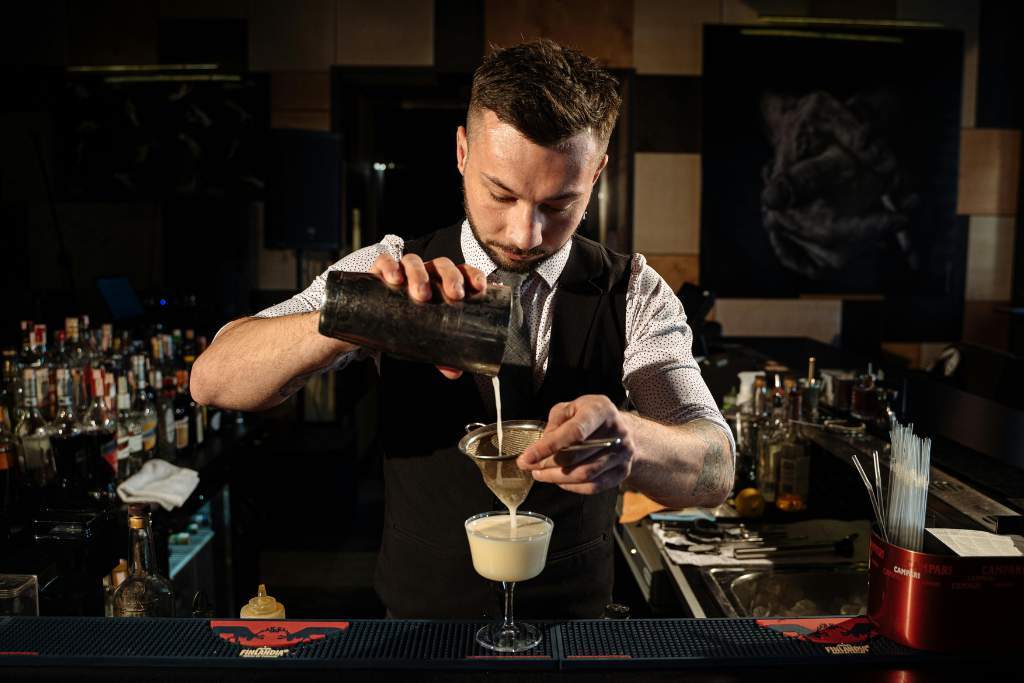
A male bartender stands behind a dimly lit bar, carefully pouring a creamy cocktail through a fine strainer into a stemmed glass. He wears a white shirt with rolled sleeves, a black vest, and a focused expression. Bottles, bar tools, and mixers line the counter and shelves behind him.
-
https://cht.edu.au/wp-content/uploads/2025/10/Bartender-Interview-Questions_-Sample-Answers_-and-Trial-Shift-Tips.jpg
A male bartender stands behind a dimly lit bar, carefully pouring a creamy cocktail through a fine strainer into a stemmed glass. He wears a white shirt with rolled sleeves, a black vest, and a focused expression. Bottles, bar tools, and mixers line the counter and shelves behind him.
-
data:image/svg+xml,%3Csvg%20xmlns='http://www.w3.org/2000/svg'%20viewBox='0%200%201200%20800'%3E%3C/svg%3E
(no alt text)
-
https://cht.edu.au/wp-content/uploads/2020/08/AdobeStock_139998652b-e1604277396692.jpg
(no alt text)
-
https://cht.edu.au/wp-content/uploads/2020/08/AdobeStock_108943277-e1604277362634.jpg
(no alt text)
-
https://cht.edu.au/wp-content/uploads/2020/08/AdobeStock_202644171-e1604277433640.jpg
(no alt text)
-
https://cht.edu.au/wp-content/uploads/2020/08/AdobeStock_172629488-e1604277467697.jpg
(no alt text)
-
data:image/svg+xml,%3Csvg%20xmlns='http://www.w3.org/2000/svg'%20viewBox='0%200%2030%200'%3E%3C/svg%3E
nationally
-
https://cht.edu.au/wp-content/uploads/2024/08/nationally.svg
nationally
-
data:image/svg+xml,%3Csvg%20xmlns='http://www.w3.org/2000/svg'%20viewBox='0%200%2040%200'%3E%3C/svg%3E
nationally
-
https://cht.edu.au/wp-content/uploads/2024/08/quality.svg
nationally
-
data:image/svg+xml,%3Csvg%20xmlns='http://www.w3.org/2000/svg'%20viewBox='0%200%2045%200'%3E%3C/svg%3E
nationally
-
https://cht.edu.au/wp-content/uploads/2024/08/art.svg
nationally
-
https://cht.edu.au/wp-content/uploads/2024/08/established.svg
nationally
-
https://cht.edu.au/wp-content/uploads/2024/08/service.svg
nationally
-
data:image/svg+xml,%3Csvg%20xmlns='http://www.w3.org/2000/svg'%20viewBox='0%200%201%201'%3E%3C/svg%3E
(no alt text)
-
https://cht.edu.au/wp-content/uploads/2022/04/cht_logo_wht.svg
(no alt text)
-
data:image/svg+xml,%3Csvg%20xmlns='http://www.w3.org/2000/svg'%20viewBox='0%200%2032%2032'%3E%3C/svg%3E
Facebook
-
https://cht.edu.au/wp-content/uploads/2023/02/facebook.svg
Facebook
-
https://cht.edu.au/wp-content/uploads/2023/02/instagram.svg
Instagram
-
https://cht.edu.au/wp-content/uploads/2023/02/youtube.svg
YouTube
-
https://cht.edu.au/wp-content/uploads/2023/02/tiktok.svg
TikTok
-
https://cht.edu.au/wp-content/uploads/2023/02/linkedin.svg
LinkedIn
-
data:image/svg+xml,%3Csvg%20xmlns='http://www.w3.org/2000/svg'%20viewBox='0%200%20404%2074'%3E%3C/svg%3E
(no alt text)
-
https://cht.edu.au/wp-content/uploads/2023/12/flags.png
(no alt text)
-
https://cht.edu.au/wp-content/themes/cht/images/close-icon.png
(no alt text)