Guide to Accredited Barista Training in Sydney
We use this page to explain accredited espresso-coffee training for readers in Sydney and New South Wales. It is a training guide; confirm our current Sydney course availability and delivery arrangements with us before booking. See our current course listings or contact us.
If you work in hospitality in New South Wales you will be used to the state adding its own layer on top of national training. RSA needs a provider approved by Liquor & Gaming NSW and produces a competency card. A Food Safety Supervisor needs a separate state-issued certificate from an RTO the NSW Food Authority has approved.
Coffee is the exception. There is no NSW barista scheme, no state card, and no approved-provider register for espresso training. What matters is the national unit and the RTO that issues it — exactly as it would in Melbourne or Brisbane.
That is not just an absence of state paperwork. The training package says it directly: no occupational licensing, certification or legislative requirement applies to the SITSS00080 Espresso Machine Operation skill set. There is no licence to make coffee anywhere in Australia, so there is nothing for NSW to add.
What does block people is a prerequisite most providers never mention until enrolment. That is covered first.
At a glance
| Unit | SITHFAB025 Prepare and serve espresso coffee |
| Training package | SIT Tourism, Travel and Hospitality |
| Prerequisite | SITXFSA005 Use hygienic practices for food safety — mandatory |
| Assessment | 10 named beverages, 3 occasions each — a minimum of 30 preparations, at commercial speed |
| Service periods required | None. Unlike SITHFAB024, SITHFAB027 and SITHFAB034 |
| Milk-dependent beverages | 7 of the 10 |
| Produces | A nationally recognised Statement of Attainment, which does not expire |
| NSW state layer | None — no card, no register, no top-up |
| Occupational licensing | None, per the SITSS00080 skill set record |
| Elective in | SIT20322 Certificate II in Hospitality, SIT30622 Certificate III in Hospitality |
| The unit above it | SITHFAB038 Plan and monitor espresso coffee service |
| USI | Generally required for nationally recognised training before issue, unless an applicable exemption applies |
| CHT in NSW | 410 Elizabeth Street, Surry Hills NSW 2010 |
The prerequisite that stops enrolments
SITHFAB025 carries a mandatory prerequisite: SITXFSA005 Use hygienic practices for food safety. A learner cannot be assessed as competent in the coffee unit without holding it, or completing it alongside.
This surprises people who think of barista work as a standalone craft. The training package treats food safety as foundational to any commercial beverage preparation, not optional.
The good news is that it is the highest-leverage unit on the scope. SITXFSA005 is a formal prerequisite for nine units in the current food and beverage stream:
| Unit | Title | Other prerequisite |
|---|---|---|
SITHFAB022 |
Clean and tidy bar areas | — |
SITHFAB023 |
Operate a bar | SITHFAB021 (RSA) |
SITHFAB024 |
Prepare and serve non-alcoholic beverages | — |
SITHFAB025 |
Prepare and serve espresso coffee | — |
SITHFAB026 |
Provide room service | — |
SITHFAB027 |
Serve food and beverage | — |
SITHFAB030 |
Prepare and serve cocktails | SITHFAB021 (RSA) and SITHFAB023 |
SITHFAB034 |
Provide table service of food and beverage | SITHFAB021 (RSA) |
SITHFAB035 |
Provide silver service | — |
Clear it once and nine units open. A free, non-accredited food safety course will satisfy a workplace food handler obligation but will not satisfy this prerequisite, because a prerequisite can only be met by the unit itself. That is the clearest practical reason to take the accredited version. See food handling or virtual food handling, which delivers the same unit online — a sensible way to clear the theory before a hands-on coffee course.
One more sequencing note if you intend to go further: four units in the stream carry two or more prerequisites — SITHFAB023 Operate a bar and SITHFAB034 Provide table service of food and beverage carry two, and SITHFAB030 Prepare and serve cocktails and SITHFAB039 Manage the sale or service of wine carry three. SITHFAB023 and SITHFAB034 both require SITHFAB021 RSA and SITXFSA005, and cocktails sits a step deeper again: SITXFSA005 → SITHFAB023 Operate a bar → SITHFAB030 Prepare and serve cocktails, which needs RSA as well. Worth knowing too that SITHFAB021 RSA gates nine units in this stream, exactly as many as the food safety unit does. Formal table service cannot be awarded until you hold SITHFAB021, whatever the venue. In NSW that compounds, because the RSA unit also needs a Liquor & Gaming NSW approved provider and produces a competency card. See restaurant waiting.
What the assessment actually requires
This is where an accredited unit separates from a barista workshop. To be assessed competent, a candidate must prepare and present each of ten named espresso beverages on three different occasions, within commercial timeframes:
| Preparation type | Beverages | Count |
|---|---|---|
| Milk-based | Caffe latte, cappuccino, flat white, piccolo latte, mocha | 5 |
| Black | Espresso (short black), long black, ristretto | 3 |
| Macchiato | Short macchiato, long macchiato | 2 |
Ten beverages, three occasions each, is a minimum of thirty separate preparations. The grouping above is a reading aid; the training package lists the ten without sorting them.
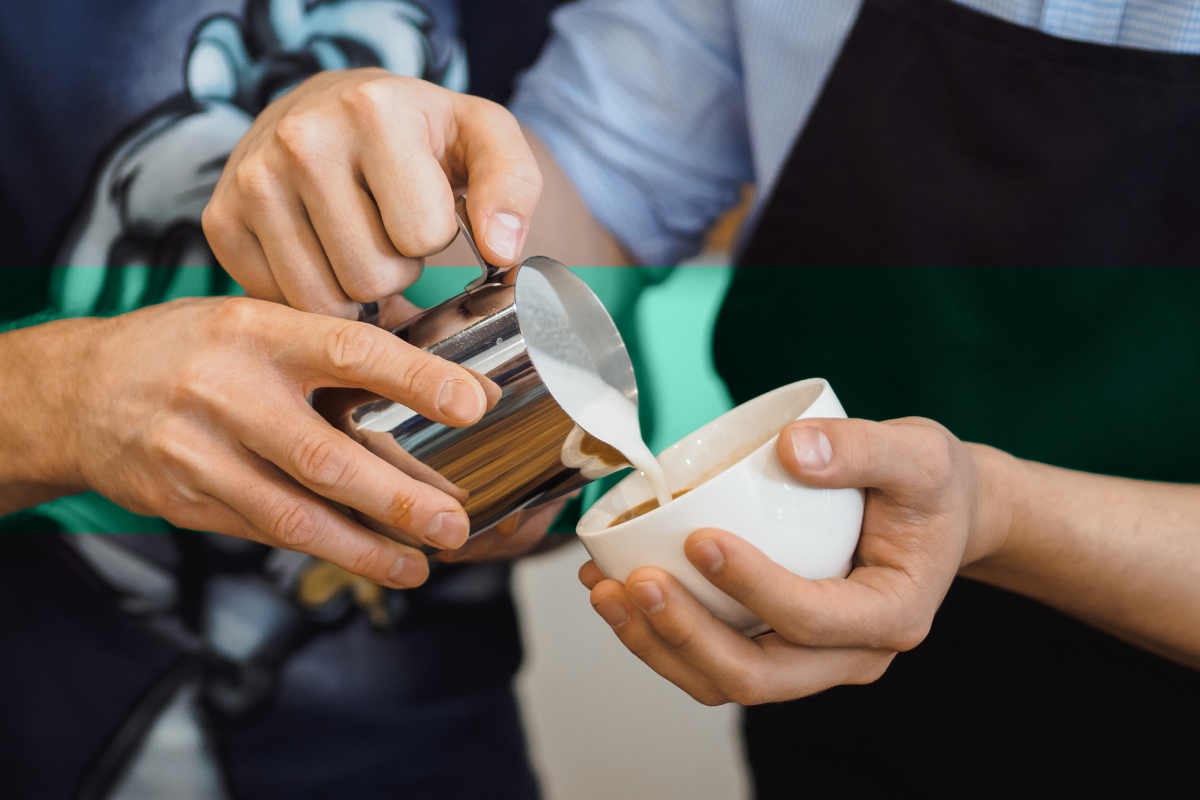
Read the middle row against the other two and the real study priority appears. Both macchiatos take milk, so only three of the ten are milk-free: espresso, long black and ristretto. Seven of the ten require textured milk, each on three occasions, which is 21 of the 30 minimum preparations. A candidate who cannot texture reliably does not fail one beverage, they fail seven. See milk texturing 101.
"Commercial timeframes" is the load-bearing phrase. It means the pace of a working venue, not a demonstration. And the three-occasions rule exists to rule out a lucky single attempt — competency here means repeatable performance.
What the unit does not require is any number of service periods. SITHFAB024 requires three including one peak, SITHFAB027 five and SITHFAB034 twelve. SITHFAB025 requires none: its whole volume is beverages and occasions. Providers sometimes advertise a peak-shift requirement for the espresso unit, and that is a delivery choice rather than a training package rule.
The unit also covers advising customers on coffee beverages, selecting and grinding beans, monitoring extraction quality and correcting it when it drifts, and using, maintaining and cleaning espresso machines and grinders. Advising customers is the first element, not an add-on, which is why product knowledge sits alongside machine technique. The unit names the five variables you adjust when extraction drifts — dose, grind, tamping technique, water flow and water pressure — and the quality factors it names are ambient humidity, crema, espresso flow, steam pressure and taste. The customer-preference options it names are accompaniments, blends, service-ware, strength, sweeteners, types of beans and types of milk.
Latte art is not separately specified in the national unit's performance or knowledge evidence. A provider may teach it as additional practical content; that is different from a requirement of SITHFAB025 itself. See latte art.
The duration check this gives you
Thirty preparations at commercial speed, plus extraction assessment, machine maintenance and customer advice, cannot be evidenced in a two-hour workshop. If a Sydney course advertises SITHFAB025 and a single short session, one of those two claims is wrong. Establish which before paying.
Why NSW adds nothing here, and where it does
Worth setting out plainly, because the contrast is the useful part for a NSW reader:
| Training | NSW state layer? | What that means |
|---|---|---|
Espresso coffee SITHFAB025 |
None | Any RTO with the unit on scope. No card, no register, and no occupational licensing at national level either |
RSA SITHFAB021 |
Yes | Provider must hold Liquor & Gaming NSW approval; a competency card is issued through Service NSW, valid 5 years |
| Food Safety Supervisor | Yes | A separate state-issued FSS certificate from an RTO approved by the NSW Food Authority, valid 5 years |
So a barista in Sydney needs the national coffee unit and nothing else from the state. The same person pulling beers would need the NSW RSA card, and the person nominated as the venue's food safety supervisor would need the NSW FSS certificate.
Two disclosures so you can plan rather than discover this later: we are not on the Liquor & Gaming NSW approved provider list and cannot produce a NSW competency card, and we are not on the NSW Food Authority's approved provider list and cannot issue the NSW FSS certificate. For coffee, neither limitation applies. See RSA in New South Wales and Food Safety Supervisor.
Accredited versus a barista workshop
The Sydney market has plenty of both, and neither is automatically better.
Accredited SITHFAB025 |
Non-accredited workshop | |
|---|---|---|
| Built on a unit code | Yes | No |
| Document | Statement of Attainment | Certificate of attendance |
| National transcript | Yes, against your USI | No |
| Employer can verify it | Through the issuing RTO | Only by trusting the provider |
| Counts toward a qualification | Yes, as an elective | No |
| Satisfies the prerequisite chain | Yes | No |
| Expires | No | n/a |
A workshop run by a skilled roaster can be excellent training. What it cannot do is appear on your transcript, be verified by an employer, count toward a qualification, or open the nine dependent units. If none of those matter to you, a workshop may be the better purchase.
How to check, in under a minute: does it name a unit code; does it name an RTO number you can verify on training.gov.au; does a Statement of Attainment arrive; does the duration fit thirty preparations; and does the provider mention the SITXFSA005 prerequisite at all? A provider that never raises the prerequisite may not be delivering the unit.
Check the code, not the brand — with the actual names
An RTO may trade under several registered business names, so the RTO code identifies the issuer. That is concrete in coffee training: the Australian Business Register records seven current registered business names for the legal entity COMPLETE HOSPITALITY TRAINING (VIC.) PTY. LTD., ABN 27 006 947 262, three of them coffee names:
| Registered business name | Registered from |
|---|---|
| COMPLETE HOSPITALITY TRAINING | 12 Dec 2011 |
| THE COFFEE SCHOOL | 25 Nov 2020 |
| Coffee School by CHT | 20 May 2021 |
| Melbourne Barista | 14 Jun 2017 |
| Victorian Bar School | 6 Mar 2018 |
| Ready Serve Achieve Melbourne | 6 Mar 2018 |
| Alchemy Institute of Australia | 12 Sep 2024 |
So a Sydney learner who encounters "The Coffee School", "Coffee School by CHT" or "Melbourne Barista" is dealing with the same legal entity as Complete Hospitality Training, and accredited training under any of them is delivered by RTO 3722. "Complete Hospitality Training" is itself a registered business name; the legal entity name carries "(VIC.)" and "PTY. LTD.". Note that "Melbourne Barista" is a business name on a national register, not a statement about where training is delivered. The dates are business-name registration dates and nothing more.
Where the unit fits in a qualification
SITHFAB025 is an elective in SIT30622 Certificate III in Hospitality and in SIT20322 Certificate II in Hospitality. Both are on our national scope and, according to our current delivery information, are available in all eight states and territories, so a Sydney learner is not restricted to the Melbourne campus for the qualification. It is not a core unit of any of our qualifications.
Completing the unit standalone is never wasted. The Statement of Attainment credit-transfers into a qualification later under Standard 1.7 of the Outcome Standards for RTOs, with no reassessment — your Statement of Attainment is the evidence. That differs from recognition of prior learning under Standard 1.6, which assesses prior skills, learning and experience and is a genuine assessment against the same thirty-preparation requirement, not a waiver. An experienced Sydney barista with no certificate is an RPL candidate. We verify evidence of equivalent prior completion, check the training-product requirements and any licensing or regulatory restrictions, and document the decision before granting credit. See ASQA’s credit-transfer guidance.
Raise either at the pre-training review, which an RTO must conduct under Standard 2.2 of the Outcome Standards for RTOs before you enrol. See skills assessment.
One qualification note worth knowing: SIT20322 Certificate II in Hospitality is recorded as equivalent to its predecessor SIT20316, so an older certificate is treated as current. SIT30622 is not equivalent to SIT30616 — the register cites changes to packaging rules, core units and the elective list.
The unit after this one
There is a senior espresso unit that almost no barista course mentions. SITHFAB038 Plan and monitor espresso coffee service is current on our scope as RTO 3722 at deliver and assess to 30 June 2032, and it assesses running a coffee operation rather than making the coffee: developing coffee menus, selecting suppliers and roasters, providing specialist advice to customers and staff, monitoring quality, and monitoring and maintaining equipment including scheduling service calls.
Its performance evidence requires coordinating an outlet's coffee operation across at least six service periods, maintaining commercial grade machines and grinders throughout, and monitoring the consistency and quality of eight named characteristics: appearance including opacity or transparency, aroma, colour, flavour, freshness, presentation, taste and volume.
And it has no prerequisite units at all — not SITXFSA005, and not SITHFAB025. So a Sydney head barista with years on the bench and no certificate can be assessed in the senior unit directly, which is the opposite of what the gated entry-level unit would lead you to expect.
Smaller than a qualification, but still coded
Units can be packaged as a nationally recognised skill set — formally coded, defined in the training package rather than assembled by a provider, and credit-transferring the same way. Two are directly relevant, and it is worth seeing what is in the espresso one:
SITSS00080 Espresso Machine Operation contains |
Title |
|---|---|
SITHFAB025 |
Prepare and serve espresso coffee |
SITXFSA005 |
Use hygienic practices for food safety — the prerequisite, included |
SITXCCS014 |
Provide service to customers |
SITXFIN007 |
Process financial transactions |
Because it contains the prerequisite, the skill set solves the sequencing problem on its own. Its target group is espresso machine operators in cafes, restaurants, bars, clubs, and function and event venues, and achievement provides credit towards SIT Training Package qualifications. And, as above, no occupational licensing, certification or legislative requirement applies to it — which is the national-level confirmation of this page's opening point about NSW.
The second relevant one is SITSS00075 Beverage Advice, aimed at the advisory side rather than the machine. We hold 81 current skill sets in total, most unadvertised, so name the code when you enquire. See all courses.
USI requirements and exemptions
For nationally recognised training, a Unique Student Identifier (USI) is generally required before a qualification or Statement of Attainment can be issued, unless an applicable exemption applies. See the official USI exemption guidance. A USI is free at usi.gov.au. If you already have one, recover it rather than creating another.
Are baristas food handlers?
Generally yes, and it is a separate obligation from the unit. Under Standard 3.2.2A of the Food Standards Code, which commenced 8 December 2023, each food handler in a category 1 or 2 business must have completed training covering safe food handling, food contamination, cleaning and sanitising, and personal hygiene — or hold skills and knowledge commensurate with the activity — before engaging in it. Handling milk, cut fruit or unpackaged pastries counts.
That obligation is lighter than most assume: it does not require nationally accredited training, no refresher period is mandated, and record keeping is optional. SITXFSA005 satisfies it and unlocks the nine units, which is the argument for the accredited route. It does not make you a Food Safety Supervisor.
On allergens and milk substitutes this page states no legal duty, because there is none in the material behind it and inventing one would be worse than the gap. Separate jugs and proper cleaning where a dairy allergy rather than an intolerance is involved is sound practice; for the legal requirement the NSW Food Authority or your local council is the authority.
What it is worth for pay
A single unit does not move your award classification. A completed Certificate III, relevant to your classification and used at work, sets a minimum of Level 4 under MA000009 (cl 18.1), MA000119 (cl 18.1) and MA000058 (cl 18.3). The fast food award, MA000003, has no equivalent provision.
Which award applies is decided by the premises, not the job title — and for coffee that matters, because coffee is served everywhere. A standalone Sydney cafe is MA000119; a cafe inside a hotel or pub is MA000009; a not-for-profit registered club is MA000058, because MA000009 clause 4.4(d)(i) expressly excludes registered clubs; a food-court counter is MA000003.
Under MA000119, Schedule A defines Level 4 as Food and beverage attendant grade 4 (tradesperson), and the award's own "standard rate" is the Level 4 rate. The ladder continues to Food and beverage supervisor at Level 5. Two caveats: the qualification must be relevant to your classification and you must make use of the skills. No pay rates are published here — award rates re-set every 1 July, so use the Fair Work Ombudsman's Pay and Conditions Tool with your award code.
Related pages
Barista course covers SITHFAB025 in full. Barista master class, coffee appreciation and latte art cover the other coffee offerings, and milk texturing 101 the seven milk beverages. Food handling covers the prerequisite, RSA in New South Wales the state's liquor scheme, and all courses lists what is advertised.
About us
We are Complete Hospitality Training, RTO 3722, CRICOS provider code 04242E. 410 Elizabeth Street, Surry Hills NSW 2010, and Level 3, 28 Elizabeth Street, Melbourne VIC 3000. Contact melbourne@cht.edu.au or +61 3 9654 1554. See about us.
The legal entity is COMPLETE HOSPITALITY TRAINING (VIC.) PTY. LTD., ABN 27 006 947 262, ACN 006 947 262.
SITHFAB025, SITHFAB038 and SITXFSA005 are on our scope of registration, within a scope holding 17 current qualifications, 81 current skill sets and 579 units. Completing a unit produces a nationally recognised Statement of Attainment.
We link to the relevant course and regulatory sources in this guide. Check those sources for current requirements, and confirm course availability, delivery, fees and entry requirements with us before enrolling.
Is there a NSW barista licence or card?
No. Unlike RSA and the Food Safety Supervisor role, coffee has no NSW state scheme, no card and no approved-provider register. The national unit from any RTO with it on scope is the whole requirement.
Is there any licence to make coffee anywhere in Australia?
No. The SITSS00080 Espresso Machine Operation skill set record states that no occupational licensing, certification or legislative requirement applies to it. The Standard 3.2.2A food handler obligation is a food safety duty on the business and the handler, not a barista licence.
What is the prerequisite for SITHFAB025?
SITXFSA005 Use hygienic practices for food safety, and it is mandatory. You must hold it or complete it alongside.
Will a free food safety course satisfy the prerequisite?
No. A prerequisite can only be satisfied by the unit itself. A free course may meet your workplace food handler obligation but opens none of the nine dependent units.
Which units does SITXFSA005 unlock?
Nine, in the food and beverage stream: SITHFAB022 clean and tidy bar areas, SITHFAB023 operate a bar, SITHFAB024 non-alcoholic beverages, SITHFAB025 espresso coffee, SITHFAB026 room service, SITHFAB027 serve food and beverage, SITHFAB030 cocktails, SITHFAB034 table service and SITHFAB035 silver service. SITHFAB023, SITHFAB030 and SITHFAB034 also require SITHFAB021 RSA, and SITHFAB030 requires SITHFAB023 on top of that.
How many coffees do I have to make?
Ten named beverages, each on three separate occasions within commercial timeframes — a minimum of thirty preparations.
Which ten beverages?
Caffe latte, cappuccino, espresso (short black), flat white, long black, piccolo latte, mocha, ristretto, short macchiato and long macchiato.
How many of those involve milk?
Seven. Only espresso, long black and ristretto are milk-free, because both macchiatos and the mocha take milk. So 21 of the 30 minimum preparations depend on textured milk.
Does SITHFAB025 require service periods or a peak shift?
No. It is the one unit in the beverage stream with no service-period requirement at all. If a provider tells you otherwise, that is their delivery model, not a training package rule.
Can an accredited barista course run in one afternoon?
No. Thirty preparations at commercial speed, plus extraction assessment, machine maintenance and customer advice, cannot be evidenced in a single short session.
Does the unit cover talking to customers?
Yes. Advising customers on coffee beverages is the first element of the unit, alongside bean selection and grinding, preparation and assessment, and machine maintenance and cleaning.
Is latte art assessed?
Latte art is not separately specified in the national SITHFAB025 evidence requirements. Providers may include it as additional practical content. Milk texturing remains part of espresso-coffee training and assessment.
What do I adjust when a shot is wrong?
The unit names five variables: dose, grind, tamping technique, water flow and water pressure.
Does a barista workshop count as SITHFAB025?
No. A non-accredited course produces no Statement of Attainment, appears on no transcript, cannot be verified through an RTO, counts toward no qualification, and satisfies no prerequisite.
Does my Statement of Attainment expire?
No. It stays on your national training transcript against your USI permanently.
I have worked as a barista for years. Is there a shortcut?
Recognition of prior learning under Standard 1.6. It is a genuine assessment against the same thirty-preparation evidence, not a waiver. If you already hold the unit from another RTO, that is credit transfer under Standard 1.7 instead, with no reassessment. We first verify the evidence and equivalence, check that the units fit your training product, and check for licensing or regulatory restrictions before granting credit. See ASQA’s credit-transfer guidance (https://www.asqa.gov.au/for-providers/standards-for-RTOs/practice-guides/quality-area-1-training-and-assessment/RPL-and-credit-transfer-practice-guide).
What comes after SITHFAB025?
SITHFAB038 Plan and monitor espresso coffee service, on our scope. It covers coffee menus, selecting suppliers and roasters, specialist advice, quality monitoring across eight named characteristics, and equipment maintenance, assessed across at least six service periods. It has no prerequisite units at all, so an experienced barista can be assessed in it directly.
Can I study this in Sydney?
The qualifications containing the unit are on our national scope and, according to our current delivery information, are available in all eight states and territories; we also have a Surry Hills address. Confirm current delivery arrangements for your location directly.
Are "The Coffee School" and "Melbourne Barista" the same organisation as CHT?
Yes. Both, with "Coffee School by CHT", are current registered business names of COMPLETE HOSPITALITY TRAINING (VIC.) PTY. LTD., ABN 27 006 947 262, on the Australian Business Register. Accredited training under them is delivered by RTO 3722.
Do I need a USI?
For nationally recognised training, a USI is generally required before your qualification or Statement of Attainment can be issued, unless an applicable exemption applies. We can explain the requirements for your enrolment. See the official USI exemption guidance (https://www.usi.gov.au/students/create-your-usi/exemptions-usi). Creating a USI is free; recover an existing one rather than creating another.
Do baristas need a food safety certificate?
If you handle milk, cut fruit or unpackaged food you are a food handler and Standard 3.2.2A applies. It need not be accredited — but SITXFSA005 satisfies it and unlocks nine units in the food and beverage stream.
Will barista training raise my pay?
Not on its own. A completed Certificate III, relevant and used at work, sets a Level 4 floor under MA000009, MA000119 and MA000058 — and under MA000119, Level 4 is the Food and beverage attendant grade 4 (tradesperson) classification.
Is there something smaller than a qualification but still coded?
Yes — SITSS00080 Espresso Machine Operation, which contains SITHFAB025, SITXFSA005, SITXCCS014 and SITXFIN007, and SITSS00075 Beverage Advice. Both on our scope.
Images on This Page
-
https://cht.edu.au/wp-content/uploads/2022/04/cht_logo_web_land.svg
logo
-
https://cht.edu.au/wp-content/uploads/2022/04/cht_logomark_webb.png
logo
-
https://cht.edu.au/wp-content/uploads/2022/04/cht_logo_rgb.svg
logo
-
https://cht.edu.au/wp-content/uploads/2021/04/banner_coffee-art.png
(no alt text)
-
https://cht.edu.au/wp-content/uploads/2020/08/AdobeStock_142744895b-e1604277380968.jpg
(no alt text)
-
https://cht.edu.au/wp-content/uploads/2020/08/Book-here-V8-2.png
Smiling barista pouring steamed milk into a cup of coffee at a café counter.
-
https://cht.edu.au/wp-content/uploads/2024/07/shutterstock_113907787.jpg
Roasted coffee beans scattered across a rustic wooden surface.
-
https://cht.edu.au/wp-content/uploads/2020/08/AdobeStock_142744895b-e1604277380968.png
Barista pouring steamed milk from a pitcher into a small cup of coffee.
-
https://cht.edu.au/wp-content/uploads/2020/08/Book-here-V8-3.png
A lady pointing her fingers to the side to show where to look to click the booking link to book in for the Barista Coffee Course in Melbourne.
-
https://lh3.googleusercontent.com/a/ACg8ocJ-puyA58EhqUTWnkEBYthdoyjGqBClo8pgjkEc62XJFyEcios=s64-c-rp-mo-br100
Wilson Jong Avatar
-
https://cht.edu.au/wp-content/uploads/wprevslider/review-images/review-image-6a8fea99820f7-0.jpg
media thumbnail 0
-
https://lh3.googleusercontent.com/a-/ALV-UjVp5co4oMmzh_oglgOJfw4qElOkMav7cqQrA0Ab73ZvHNz3jw=s64-c-rp-mo-br100
Daniel Rose Avatar
-
https://lh3.googleusercontent.com/a/ACg8ocKZhz7LC6bpJvfFepZx8DP_cOt19k9V9mwd74VIXhr4ZBc-Jg=s64-c-rp-mo-br100
Deepak Pandey Avatar
-
https://lh3.googleusercontent.com/a/ACg8ocKIRvEWLr_ZRqWJ1vjJS5d8mXyP8L1PGSXIocv7xCA7hdfsRg=s64-c-rp-mo-br100
Eva Di Betta Avatar
-
https://lh3.googleusercontent.com/a/ACg8ocLRBODw2wvVCVq32OhlqXf0vvSJ2X7v02_5F8C9vYpi24c9BA=s64-c-rp-mo-br100
Johanna Gruber Avatar
-
https://lh3.googleusercontent.com/a/ACg8ocILWfQ1_yhwr2yRiNWG23i-AEJH4AAWPbc2DruvBzdvTgzsJj0=s64-c-rp-mo-br100
Chloe Morgan Avatar
-
https://lh3.googleusercontent.com/a-/ALV-UjVoB0LNfm2rKFH6CBWC3BylC9uquuPIvNcdfZ-uqtsTYdSFI7oB=s64-c-rp-mo-br100
Prajwal Tiwary Avatar
-
https://lh3.googleusercontent.com/a-/ALV-UjUdbsguY0kA7b-hExHRAu8hXi6gsBspMUBXgQG48lQtKq7JTfc=s64-c-rp-mo-br100
Aiden Tran (Hurricade) Avatar
-
https://lh3.googleusercontent.com/a/ACg8ocJ6zQ15V-c8PmfUip7aDbGRv5Ezck6buI3o_whW9EH83PdkrQ=s64-c-rp-mo-br100
kristy Nicholls Avatar
-
https://lh3.googleusercontent.com/a/ACg8ocL4ZRzGN_uhMscCsHExvs8QVTa_5FN5A_UL30u6fyF1smEhvw=s64-c-rp-mo-br100
David Peter Nair Avatar
-
https://lh3.googleusercontent.com/a/ACg8ocJOzo657HBfWpdQbk3Pcv75BjERtCxH3gWnpFS3YQOwUhC5Ew=s64-c-rp-mo-br100
Leijing Shan Avatar
-
https://lh3.googleusercontent.com/a-/ALV-UjUSACDMz7QBi3EqFlgrZgYnnqHiq-FRQOMSEPB8r5vldRbY9y0e=s64-c-rp-mo-br100
Yorda Avatar
-
https://lh3.googleusercontent.com/a/ACg8ocJmXLU2_G7iqnAIvUTpP5a2ucqac8UQZBvmA1Ojq8PTPjoX=s64-c-rp-mo-br100
Senoleita Avatar
-
https://lh3.googleusercontent.com/a/ACg8ocKqM3oNIJCIXWrsLwNnEuXLXXLX0BmPYHGl4MR0o4oQp0xewA=s64-c-rp-mo-br100
Ava Fraser Avatar
-
https://lh3.googleusercontent.com/a/ACg8ocLPh4gzfKLPKcG228rZ_Gay9Vs1DqdMUvYW2pRNs80w3Q5y7Q=s64-c-rp-mo-ba2-br100
Thảo Trần Avatar
-
https://cht.edu.au/wp-content/uploads/wprevslider/review-images/review-image-6a0d660a1455a-0.jpg
media thumbnail 0
-
https://lh3.googleusercontent.com/a-/ALV-UjVdkOTdbHd9qL3nEyv1CA5ovNpUpU13MqLZaa-kX8v6WP9F6mtN=s64-c-rp-mo-ba2-br100
Luke Willis Avatar
-
https://lh3.googleusercontent.com/a-/ALV-UjUwvCwkXjSWn7_S2qV1Cyb4zXFsLA-wXIt1EiqanPR_QSfKrmxi=s64-c-rp-mo-ba4-br100
Axel Gomez Avatar
-
https://lh3.googleusercontent.com/a-/ALV-UjX6tAd5ZRPSbwkGIXRajo4rNMJDcTGXxHboMZqzx8wZAfOvvU4=s120-c-rp-mo-br100
Rahul Aravindth Avatar
-
https://lh3.googleusercontent.com/a-/ALV-UjUASBtqUpwR0elJMaY2zqzGSuxv9zlHQxkyKtDBbbQeEWs-mYCKMQ=s120-c-rp-mo-br100
Alex Dimelow Avatar
-
https://lh3.googleusercontent.com/a-/ALV-UjUPKOsxrfcSAuyfLzzMwlNb-tKCcco8a1ViIWk43YxlhSaxtds=s120-c-rp-mo-br100
Jeremy Rocca Avatar
-
https://lh3.googleusercontent.com/a/ACg8ocK9FFeitBJaC2-7F09h51sCAAnjDUcz_mFshLFl1LCW9DLx0A=s120-c-rp-mo-br100
Alkim Avatar
-
https://lh3.googleusercontent.com/a-/ALV-UjU0nAqPYVt9FJNqZjKKKj2sSn3KGYDsPo-q05G8ru5krvmL3uRL=s120-c-rp-mo-br100
Lawrence Miha Avatar
-
https://cht.edu.au/wp-content/uploads/2024/08/nationally.svg
nationally
-
https://cht.edu.au/wp-content/uploads/2024/08/quality.svg
nationally
-
https://cht.edu.au/wp-content/uploads/2024/08/art.svg
nationally
-
https://cht.edu.au/wp-content/uploads/2024/08/established.svg
nationally
-
https://cht.edu.au/wp-content/uploads/2024/08/service.svg
nationally
-
https://cht.edu.au/wp-content/uploads/2022/04/cht_logo_wht.svg
(no alt text)
-
https://cht.edu.au/wp-content/uploads/2023/02/facebook.svg
Facebook
-
https://cht.edu.au/wp-content/uploads/2023/02/instagram.svg
Instagram
-
https://cht.edu.au/wp-content/uploads/2023/02/youtube.svg
YouTube
-
https://cht.edu.au/wp-content/uploads/2023/02/tiktok.svg
TikTok
-
https://cht.edu.au/wp-content/uploads/2023/02/linkedin.svg
LinkedIn
-
https://cht.edu.au/wp-content/uploads/2023/12/flags.png
(no alt text)
-
https://cht.edu.au/wp-content/themes/cht/images/close-icon.png
(no alt text)